Question
In hydrogen atom, there is single electron only but many lines in its emission spectrum. How it does? Explain the reason.

Answer

Each atom have some definite energy levels. In normal state electron of hydrogen atom remains in low energy level. When atom gets energy from outside, electron jumps into higher energy level and leave the minimum energy level i.e. it becomes excited. Electron leave the higher energy level within $10^{-8} sec$. Now it can return in lowest energy level or can be return passing through the lower energy level to lowest one. Since, any light source (hydrogen lamp) has large numbers. of atoms therefore all possible transition initiates in source and many lines has seen in spectrum.

Need a full question paper?

Generate a complete, print-ready paper with questions like this in minutes — across 16+ boards, with answer keys.
Start Generating Free

Similar questions

A heating element using nichrome connected to a 230 V supply draws an initial current of 3.2 A which settles after a few seconds to a steady value of 2.8 A. What is the steady temperature of the heating element if the room temperature is 27${ }^{\circ} C$ ? Temperature coefficient of resistance of nichrome averaged over the temperature range involved is $1.70 \times 10^{-4}{ }^{\circ} C ^{-1}$.
Is the colour of 620nm light and 780nm light same? Is the colour of 620nm light and 621nm light same? How many colours are there in white light?
A beam of light having wavelengths distributed uniformly between 450nm to 550nm passes through a sample of hydrogen gas. Which wavelength will have the least intensity in the transmitted beam?
ls it always true that for two sources of equal intensity, the number of photons emitted in a given time are equal?
Sketch the graph showing variation of stopping potential with frequency of incident radiations for two photosensitive materials $A$ and $B$ having threshold frequencies $v_{A > }v_{B.}$
  1. In which case is the stopping potential more and why?
  2. Does the slope of the graph depend on nature of the material used? Explain.
​​​​​​​
A particle goes in a circle of radius 2.0cm. A concave mirror of focal length 20cm is placed with its principal axis passing through the centre of the circle and perpendicular to its plane. The distance between the pole of the mirror and the centre of the circle is 30cm. Calculate the radius of the circle formed by the image.
Water near the bed of a deep river is quiet while that near the surface flows. Give reasons.
obtain the frequency of revolution of the electron in its circular orbit. Does the answer depend on the speed of the electron? Explain.
Obtain the answers $(a)$ to $(b)$ in Exercise $7.13$ if the circuit is connected to a high frequency supply $(240V, 10kHz).$ Hence, explain the statement that at very high frequency, an inductor in a circuit nearly amounts to an open circuit. How does an inductor behave in a dc circuit after the steady state?
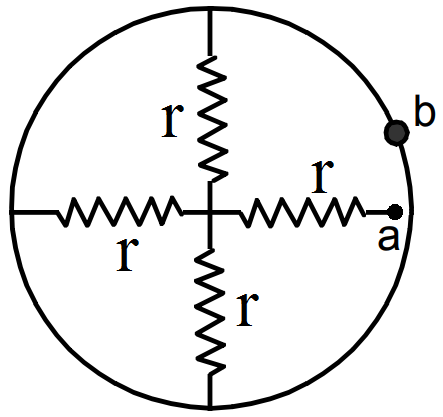
Find the equivalent resistances of the networks shown in the figure. between the points a and b.
  1.  
  1.  
  1.  
  1.  
  1.