MCQ
In hydrogen atom which quantity is integral multiple of $\frac{h}{{2\pi }}$
  • Angular momentum
  • B
    Angular velocity
  • C
    Angular acceleration
  • D
    Momentum

Answer

Correct option: A.
Angular momentum
a
(a)

Need a full question paper?

Generate a complete, print-ready paper with questions like this in minutes — across 16+ boards, with answer keys.
Start Generating Free

Similar questions

Ice at $-20\,^oC$ is added to $50\,g$ of water at $40\,^oC.$ When the temperature of the mixture reaches $0\,^oC,$ it is found that $20\,g$ of ice is still unmelted. The amount of ice added to the water was close to ........$g$ (Specific heat of water $= 4.2\,J/g/^oC)$ Heat of fusion of water at $0^oC = 334\,J/g$ )
If the screw on a screw-gauge is given six rotations, it moves by $3\; \mathrm{mm}$ on the main scale. If there are $50$ divisions on the circular scale the least count of the screw gauge is
Reactance of a capacitor of capacitance $C\mu F$ for $ac$ frequency $\frac{{400}}{\pi }$ $Hz$ is $25\Omega $. The value $C$ is.....$\mu F$
A hall has the dimensions $10\,m \times 12\,m \times 14\,m.$A fly starting at one corner ends up at a diametrically opposite corner. What is the magnitude of its displacement...........$m$
A very broad elevator is going up vertically with a constant acceleration of $2\,m / s ^2$. At the instant when its velocity is $4\,m / s$ a ball is projected from the floor of the lift with a speed of $4\,m / s$ relative to the floor at an elevation of $30^{\circ}$. The time taken by the ball to return the floor is $..............\,s$ $\left(g=10\,m / s ^2\right)$
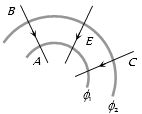
In moving from $A$ to $B$ along an electric field line, the electric field does $6.4 \times {10^{ - 19}}\,J$ of work on an electron. If ${\phi _1},\;{\phi _2}$ are equipotential surfaces, then the potential difference $({V_C} - {V_A})$ is.....$V$
The resistance of the series combination of two resistance is $S$. When they are joined in parallel the total resistance is $P$. If $S = nP$, then the minimum possible value of $n$ is
Which of the following shows the correct relationship between the pressure $'P'$ and density $\rho $ of an ideal gas at constant temperature ?
Match List$-I$ with List$-II$

List$-I$ List$-II$
$(a)$ $h$ (Planck's constant) $(i)$ $\left[ M L T ^{-1}\right]$
$(b)$ $E$ (kinetic energy) $(ii)$ $\left[ M L ^{2} T ^{-1}\right]$
$(c)$ $V$ (electric potential) $(iii)$ $\left[ M L ^{2} T ^{-2}\right]$
$(d)$ $P$ (linear momentum) $( iv )\left[ M L ^{2} I ^{-1} T ^{-3}\right]$

Choose the correct answer from the options given below
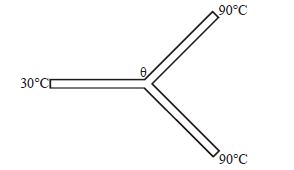
Three identical rods have been joined at a junction to make it a $Y$ shape structure. If two free ends are maintained at $90\,^oC$ and the third end is at $30\,^oC$ , then what is the junction temperature $\theta $ ?......... $^oC$