MCQ
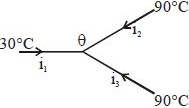
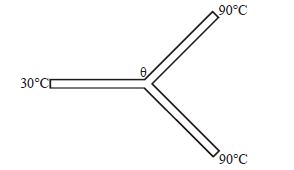
Three identical rods have been joined at a junction to make it a $Y$ shape structure. If two free ends are maintained at $90\,^oC$ and the third end is at $30\,^oC$ , then what is the junction temperature $\theta $ ?......... $^oC$
  • A
    $40$
  • B
    $50$
  • C
    $60$
  • $70$

Answer

Correct option: D.
$70$
d
Themal resistance $=\frac{\mathrm{L}}{\mathrm{KA}}=$ same for all $=\mathrm{R}(\mathrm{let})$ using kirchoff's law for heat current

$\mathrm{i}_{1}+\mathrm{i}_{2}+\mathrm{i}_{3}=0$

$\Rightarrow \frac{30-\theta}{R}+\frac{90-\theta}{R}+\frac{90-\theta}{R}=0$

$30-\theta+180-2 \theta=0 \Rightarrow 210=3 \theta \Rightarrow \theta=70^{\circ} \mathrm{C}$

Need a full question paper?

Generate a complete, print-ready paper with questions like this in minutes — across 16+ boards, with answer keys.

Start Generating Free

Similar questions

Four identical hollow cylindrical columns of mild steel support a big structure of mass $50 \times 10^{3} {kg}$, The inner and outer radii of each column are $50\; {cm}$ and $100 \;{cm}$ respectively. Assuming uniform local distribution, calculate the compression strain of each column. [Use $\left.{Y}=2.0 \times 10^{11} \;{Pa}, {g}=9.8\; {m} / {s}^{2}\right]$
If ${\lambda _p}$ and ${\lambda _\alpha }$ be the de-Broglie's wavelengths associated with protons and $\alpha  - $ particles of equal kinetic energies, then
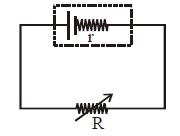
A new flashlight cell of $e.m.f.$ $1.5\, volts$ gives a current of $15\, amps$, when connected directly to an ammeter of resistance $0.04\,\Omega $. The internal resistance of cell is ........... $\Omega$ 
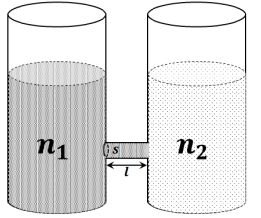
As shown schematically in the figure, two vessels contain water solutions (at temperature $T$ ) of potassium permanganate $\left( KMnO _4\right)$ of different concentrations $n_1$ and $n_2\left(n_1>n_2\right)$ molecules per unit volume with $\Delta n=\left(n_1-n_2\right) \ll n_1$. When they are connected by a tube of small length $\ell$ and cross-sectional area $S , KMnO _4$ starts to diffuse from the left to the right vessel through the tube. Consider the collection of molecules to behave as dilute ideal gases and the difference in their partial pressure in the two vessels causing the diffusion. The speed $v$ of the molecules is limited by the viscous force $-\beta v$ on each molecule, where $\beta$ is a constant. Neglecting all terms of the order $(\Delta n)^2$, which of the following is/are correct? ( $k_B$ is the Boltzmann constant)-

$(A)$ the force causing the molecules to move across the tube is $\Delta n k_B T S$

$(B)$ force balance implies $n_1 \beta v \ell=\Delta n k_B T$

$(C)$ total number of molecules going across the tube per sec is $\left(\frac{\Delta n}{\ell}\right)\left(\frac{k_B T}{\beta}\right) S$

$(D)$ rate of molecules getting transferred through the tube does not change with time

Which of the following graphs represent the variation of power loss in the external load with external resistance $R$?
If the magnetic flux is expressed in weber, then magnetic induction can be expressed in
Which of the following is more closed to a black body?
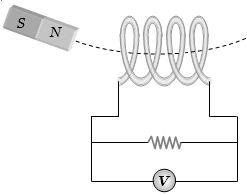
A magnet is made to oscillate with a particular frequency, passing through a coil as shown in figure. The time variation of the magnitude of $e.m.f$. generated across the coil during one cycle is
An engineer claims to have made an engine delivering $10 kW$ power with fuel consumption of $1 g/sec$. The calorific value of the fuel is $2 kcal/g$. Is the claim of the engineer
Three condensers each of capacitance $2F$ are put in series. The resultant capacitance is.........$F$