MCQ
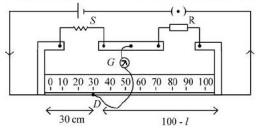
In meter bridge experiment for measuring unknown resistance ' $S$ ', the null point is obtained at a distance $30 cm$ from the left side as shown at point $D$. If $R$ is $5.6 k \Omega$, then the value of unknown resistance ' $S$ ' will be $\Omega .$
  • A
    $240$
  • B
    $24$
  • C
    $48$
  • $2400$

Answer

Correct option: D.
$2400$
d
$\frac{ S }{30}=\frac{5.6 \times 10^{3}}{70}$

$S =\frac{3}{7} \times 5.6 \times 10^{3}=2400$

Need a full question paper?

Generate a complete, print-ready paper with questions like this in minutes — across 16+ boards, with answer keys.

Start Generating Free

Similar questions

Ionization energy of a hydrogen $-$ like ion $A$ is greater than that of another hydrogen $-$ like ion $B$. Let $r, u, E$ and $L$ represent the radius of the orbit, speed of the electron, energy of the atom and orbital angular momentum of the electron respectively. In ground state :
The light reflected by a plane mirror may form a real image
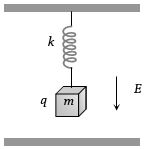
Time period of a block suspended from the upper plate of a parallel plate capacitor by a spring of stiffness $k$ is $T$. When block is uncharged. If a charge $q$ is given to the block them, the new time period of oscillation will be
A circular loop of radius $r$ is carrying current I A. The ratio of magnetic field at the centre of circular loop and at a distance $r$ from the center of the loop on its axis is:
A person's near point is 50 cm and his far point is 3 m. Power of the lenses he requires for
(i) reading and (ii) for seeing distant stars are
Rest mass energy of an electron is 0.54 MeV. If velocity of the electron is 0.8 c, then K.E. of the electron is
A triode has a plate resistance of $10 k \Omega$ and amplification factor $24$. If the input signal voltage is $0.4\, V$ $(r.m.s.)$, and the load resistance is $10\, k$ ohm, then, the output voltage $(r.m.s.)$ is......$V$
The clear sky appears blue because:
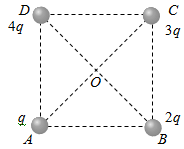
Charges q, 2q, 3q and 4q are placed at the corners A, B, C and D of a square as shown in the following figure. The direction of electric field at the centre of the square is along
Two parallel conductors A and B of equal lengths carry currents I and 10 I, respectively, in the same direction. Then