MCQ
In nuclear reactions, we have the conservation of
  • A
    Mass only
  • B
    Energy only
  • C
    Momentum only
  • Mass, energy and momentum

Answer

Correct option: D.
Mass, energy and momentum
d
(d)No energy and mass enters or goes out of the system of the reaction and no external force is assumed to act.

Need a full question paper?

Generate a complete, print-ready paper with questions like this in minutes — across 16+ boards, with answer keys.

Start Generating Free

Similar questions

The electrostatic potential due to an electric dipole is directly proportional to:
For the refraction of light through a prism
Two coherent sources of light interfere. The intensity ratio of two sources is $1: 4$. For this interference pattern if the value of $\frac{I_{\max }+I_{\min }}{I_{\max _{\max }}-I_{\min }}$ is equal to $\frac{2 \alpha+1}{\beta+3}$, then $\frac{\alpha}{\beta}$ will be.
A point charge $+q,$ is placed at a distance d from an isolated conducting plane. The field at a point $P$ on the other side of the plane is:
A polaroid is placed at  $45^{o}$  to an incoming light of intensity ${I_0}$. Now the intensity of light passing through polaroid after polarisation would be
If intensity of each wave in the observed interference pattern in Young's double slit experiment is $I_0$. then for some point $P$ where the phase difference is $\phi $ , intensity $I$ will be
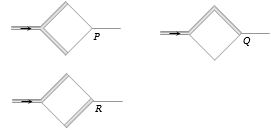
Two thick wires and two thin wires, all of the same materials and same length form a square in the three different ways $P$, $Q$ and $R$ as shown in fig with current connection shown, the magnetic field at the centre of the square is zero in cases
A parallel plate capacitor has a capacity C. The separation between the plates is doubled and a dielectric medium is introduced between the plates. If the capacity now becomes 2C, the dielectric constant of the medium is
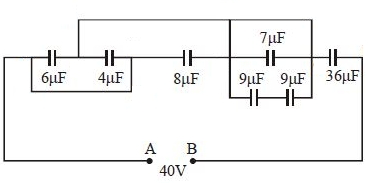
In the following diagram, the charge and potential difference across $8\, \mu F$ capacitance will be nearly
The drift velocity does not depend upon