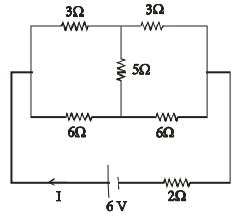
In order to increase the resistance of a given wire of uniform cross section to four times its value, a fraction of its length is stretched uniformly till the full length of the wire becomes $\frac{3}{2}$ times the original length what is the value of this fraction?
Advanced
Download our app for free and get started
Let, the length of wire $=l$ unit Fraction required $=a$
Then, the lenght of wire which is stretched $=a l$ $R_{l}=R_{(w i r e)}=\frac{\rho l}{A}$
$R_{l-a l}=\frac{\rho(l-a l)}{A}=R_{l(1-a)}$
$R_{a l}=\frac{\rho a l}{A}=a R_{l}$
On stretching $'al'$ length of wire, new length of $^{\prime} a l^{\prime}$ part$:$
$l-a l+l^{\prime}=\frac{3 l}{2}$
$l^{\prime}=l\left(\frac{1}{2}+a\right)$
Volume of wire $' a l^{\prime}$ is same$:$
$l^{\prime} A^{\prime}=(a l) A$
$l\left(\frac{1}{2}+a\right) A^{\prime}=(a l) A$
$A^{\prime}=\frac{a A}{\left(\frac{1}{2}+a\right)}$
Now, resistance of stretched parts,
$R^{\prime}=\frac{\rho \times l^{\prime}}{A^{\prime}}=\frac{\rho \times l\left(\frac{1}{2}+a\right)}{\frac{a A}{\frac{1}{2}+a}}=\frac{\rho l}{A} \frac{\left(\frac{1}{2}+a\right)^{2}}{a}$
$\Rightarrow R^{\prime}=\frac{R_{l}\left(\frac{1}{2}+a\right)^{2}}{a}$
According to the question,
$R_{l-a l}+R^{\prime}=4 R_{l}$
$\Rightarrow R_{l(1-a)}+R_{l} \frac{\left(\frac{1}{2}+a\right)^{2}}{a}=4 R_{l}$
$\Rightarrow a-a^{2}+\frac{1}{4}+a^{2}+a=4 a$
$\Rightarrow \frac{1}{4}+2 a=4 a$
$\Rightarrow \frac{1}{4}=4 a-2 a$
$\Rightarrow \frac{1}{4}=2 a$
$\Rightarrow a=\frac{1}{8}$

Download our appand get started for free
Experience the future of education. Simply download our apps or reach out to us for more information. Let's shape the future of learning together!No signup needed.*
Similar Questions
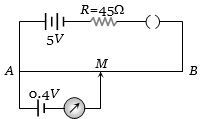
- 1In given figure, the potentiometer wire $AB$ has a resistance of $5$ $\Omega$ and length $10\, m$. The balancing length $AM$ for the $emf$ of $0.4\, V$ is ............... $m$View Solution
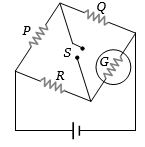
- 2The figure shows a circuit diagram of a ‘Wheatstone Bridge’ to measure the resistance $G$ of the galvanometer. The relation $\frac{P}{Q} = \frac{R}{G}$ will be satisfied only whenView Solution
- 3When a current of $2\, A$ flows in a battery from negative to positive terminal, the potential difference across it is $12\, V$. If a current of $3\, A$ flows in the opposite direction potential difference across the terminals of the battery is $15\, V$, the $emf$ of the battery is ............... $\mathrm{V}$View Solution
- 4View SolutionAssertion : Kirchoff 's junction rule follows from conservation of charge.
Reason : Kirchoff 's loop rule follows from conservation of momentum.
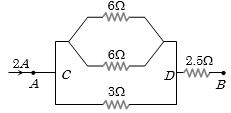
- 5The equivalent resistance and potential difference between $A$ and $B$ for the circuit is respectivelyView Solution
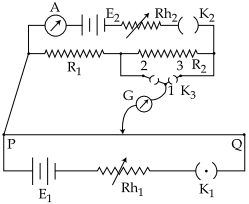
- 6A potentiometer $PQ$ is set up to compare two resistances as shown in the figure. The ameter $A$ in the circuit reads $1.0\, A$ when two way key $K_3$ is open. The balance point is at a length $l_1\, cm$ from $P$ when two way key $K_3$ is plugged in between $2$ and $1$ , while the balance point is at a length $l_2\, cm$ from $P$ when key $K_3$ is plugged in between $3$ and $1$ . The ratio of two resistances $\frac{{{R_1}}}{{{R_2}}}$ is found to beView Solution
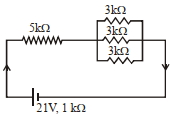
- 7In the figure given, the electric current flowing through the $5\, k \Omega$ resistor is $'x' mA.$View Solution
The value of $x$ to the nearest integer is .........
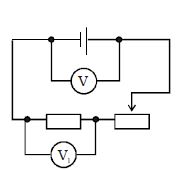
- 8If the rheostat slider were to move from the extreme right to the far left, How will the reading of voltmeter $V_1$ change?View Solution
- 9Three resistances $P, Q, R$ each of $2 \,\,\Omega$ and an unknown resistance $S$ form the four arms of a Wheatstone bridge circuit. When a resistance of $6 \,\,\Omega$ is connected in parallel to $S$ the bridge gets balanced. What is the value of $S\,?$ ............... $\Omega$View Solution
- 10A battery of $6\,V$ is connected to the circuit as shown below. The current I drawn from the battery is:View Solution