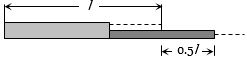
In order to quadruple the resistance of a uniform wire, a part of its length was uniformly stretched till the final length of the entire wire was $1.5$ times the original length, the part of the wire was fraction equal to
Diffcult
Download our app for free and get started
(a) Let $l$ be the original length of wire and $x$ be its length stretched uniformly such that final length is $1.5\, l$
Then $4R = \rho \frac{{(l - x)}}{A} + \rho \frac{{(0.5l + x)}}{{A'}}$where $A' = \frac{x}{{(0.5l + x)}}A$
$4\rho \frac{l}{A} = \rho \frac{{l - x}}{A} + \rho \frac{{{{(0.5l + x)}^2}}}{{xA}}$
or $4l = l - x + \frac{1}{4}\frac{{{l^2}}}{x} + \frac{{{x^2}}}{x} + \frac{{lx}}{x}$ or $\frac{x}{l} = \frac{1}{8}$
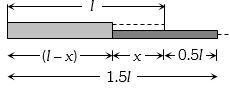
Then $4R = \rho \frac{{(l - x)}}{A} + \rho \frac{{(0.5l + x)}}{{A'}}$where $A' = \frac{x}{{(0.5l + x)}}A$
$4\rho \frac{l}{A} = \rho \frac{{l - x}}{A} + \rho \frac{{{{(0.5l + x)}^2}}}{{xA}}$
or $4l = l - x + \frac{1}{4}\frac{{{l^2}}}{x} + \frac{{{x^2}}}{x} + \frac{{lx}}{x}$ or $\frac{x}{l} = \frac{1}{8}$

Download our appand get started for free
Experience the future of education. Simply download our apps or reach out to us for more information. Let's shape the future of learning together!No signup needed.*
Similar Questions
- 1An electric kettle takes $4\, A$ current at $220\,V.$ How much time will it take to boil $1\,\, kg$ of water circuits are consequences of from temperature $20\,^o C\, ?$ The temperature of $(a)$ conservation of energy and electric charge boiling water is $100\,^o C.$ ............... $min$View Solution
- 2What is the current $(i)$ in the circuit as shown in figure ........... $A$View Solution
- 3There are a large number of cells available, each marked $(6 \,V , 0.5 \,\Omega)$ to be used to supply current to a device of resistance $0.75 \,\Omega$, requiring $24 \,A$ current. How should the cells be arranged, so that power is transmitted to the load using minimum number of cells?View Solution
- 4A carbon resistor has colour strips as violet, yellow brown and golden. The resistance is .............. $\Omega$View Solution
- 5View SolutionIf the length of potentiometer wire is increased, then the length of the previously obtained balance point will
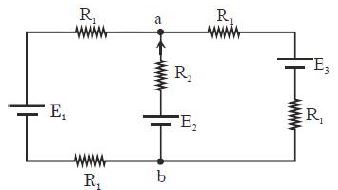
- 6For the circuit shown, with ${R_1} = 1.0\,\Omega $, ${R_2} = 2.0\,\Omega $, ${E_1} = 2\,V$ and ${E_2} = {E_3} = 4\,V$, the potential difference between the points $‘a’$ and $‘b’$ is approximately (in $V$)View Solution
- 7For a cell of $e.m.f.$ $2\,V$, a balance is obtained for $50\, cm$ of the potentiometer wire. If the cell is shunted by a $2\,\Omega $ resistor and the balance is obtained across $40\, cm$ of the wire, then the internal resistance of the cell is ............. $\Omega $View Solution
- 8A heater draws a current of $2\,A$ when connected to a $250\,V$ source. The rate of energy dissipation is ............. $W$View Solution
- 9$4$ bulbs marked $40\, W$, $250\, V$ are connected in series with $250\, V$ mains. The total power is ............. $W$View Solution
- 10A battery of $e.m.f.$ $E$ and internal resistance $r$ is connected to a variable resistor $R$ as shown here. Which one of the following is trueView Solution