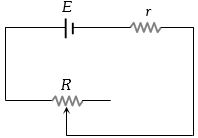
A battery of $e.m.f.$ $E$ and internal resistance $r$ is connected to a variable resistor $R$ as shown here. Which one of the following is true
Easy
Download our app for free and get started
(b) For power to be maximum
External resistance $=$ Equivalent internal resistance of the circuit

Download our appand get started for free
Experience the future of education. Simply download our apps or reach out to us for more information. Let's shape the future of learning together!No signup needed.*
Similar Questions
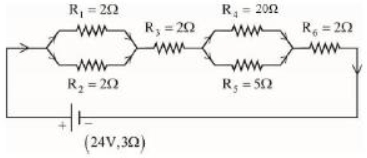
- 1As shown in the figure, a network of resistors is connected to a battery of $2\,V$ with an internal resistance of $3\,\Omega$. The currents through the resistors $R_4$ and $R_5$ are $I_4$ and $I_5$ respectively. The values of $I_4$ and $I_5$ are :View Solution
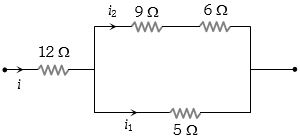
- 2In the following circuit, $5$ $\Omega$ resistor develops $45$ $J/s$ due to current flowing through it. The power developed per second across $12$ $\Omega$ resistor is ............. $W$View Solution
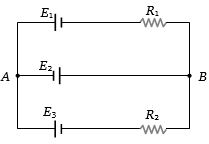
- 3In the circuit shown here, $E_1 = E_2 = E_3 = 2 V$ and $R_1 = R_2 = 4\,ohms$. The current flowing between points $A$ and $B$ through battery $E_2$ isView Solution
- 4The electric field $E$, current density $J$ and conductivity $\sigma$ of a conductor are related asView Solution
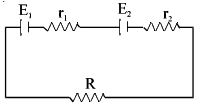
- 5Under what condition current passing through the resistance $R$ can be increased by short circuiting the battery of emf $E_2$. The internal resistances of the two batteries are $r_1$ and $r_2$ respectively.View Solution
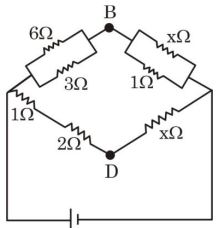
- 6If the potential difference between $B$ and $D$ is zero, the value of $x$ is $\frac{1}{n} \Omega$. The value of $n$ is .......View Solution
- 7A $2\, volt$ battery, a $15\,\Omega $ resistor and a potentiometer of $100\, cm$ length, all are connected in series. If the resistance of potentiometer wire is $5\,\Omega $, then the potential gradient of the potentiometer wire is ............... $V/cm$View Solution
- 8View SolutionCurrent provided by a battery is maximum when
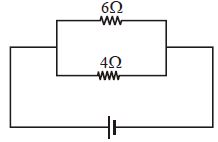
- 9In the circuit shown, the power developed in the $6\,\Omega $ resistor is $6\,W.$ The power developed in the $4\,\Omega $ resistor is .............. $W$View Solution
- 10When a wire of uniform cross-section $a$, length $l$ and resistance $R$ is bent into a complete circle, resistance between any two of diametrically opposite points will beView Solution