MCQ
In $P-N$ junction, avalanche current flows in circuit when biasing is
  • A
    Forward
  • Reverse
  • C
    Zero
  • D
    Excess

Answer

Correct option: B.
Reverse
b
(b)At a particular reverse voltage in $PN-$junction, a huge current flows in reverse direction known as avalanche current.

Need a full question paper?

Generate a complete, print-ready paper with questions like this in minutes — across 16+ boards, with answer keys.

Start Generating Free

Similar questions

A student connects a long air cored - coil of manganin wire to a $100\,\, V$ $D.C.$ supply and records a current of $25\, amp$. When the same coil is connected across $100\, V$. $50\,Hz$ $a.c.$ the current reduces to $20\, A$ , the reactance of the coil is......$\Omega$
A steady current of 5 amps is maintained for 45 mins. During this time it deposits 4.572 gms of zinc at the cathode of a voltameter. E.C.E. of zinc is
Semiconductor is damaged by the strong current due to
When a plane polarised light is passed through an analyser and analyser is rotated through $90^o ,$  the intensity of the emerging light
A condenser has a capacity $2\,\mu \,F$ and is charged to a voltage of $50\, V$. The energy stored is
A current is flowing through a thin cylindrical shell of radius $R$. If energy density in the medium, due to magnetic field, at a distance $r$ from axis of the shell is equal to $U$ then which of the following graphs is correct
Two condensers of capacity 0.3 μF and 0.6 μF respectively are connected in series. The combination is connected across a potential of 6 volts . The ratio of energies stored by the condensers will be 
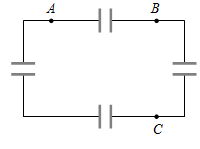
Four capacitors of each of capacity 3μF are connected as shown in the adjoining figure. The ratio of equivalent capacitance between A and B and between A and C will be


If the distance between H and Cl in HCl molecule is 1.28 A, then the value of electric dipole moment of this molecule will be (in Coulomb-meter):
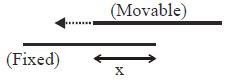
A parallel-plate capacitor consists of a fixed plate and a movable plate that is allowed to slide in the direction parallel to the plates. Let $x$ be the distance of overlap, as shown in the figure. The separation between the plates is fixed. Assume that the plates are electrically isolated, so that their charges $±Q$ are constant. Force on the movable plate is proportional to