MCQ
In parallel combination of capacitors, the effective capacitance:
- ADecreases.
- BIncreases.
- CRemains same.
- DNone.
Generate a complete, print-ready paper with questions like this in minutes — across 16+ boards, with answer keys.
 energy. The emitted particle is
|
(a) Neutron |
(b) Proton |
(c) α - particle |
(d) Neutrino |
An uncharged capacitor is connected to a battery. On charging the capacitor
|
(a) All the energy supplied is stored in the capacitor |
|
(b) Half the energy supplied is stored in the capacitor |
|
(c) The energy stored depends upon the capacity of the capacitor only |
|
(d) The energy stored depends upon the time for which the capacitor is charged |
In the circuit shown below, The reading of the voltmeter V is

|
(a) 12 V |
(b) 8 V |
(c) 20 V |
(d) 16 V |
100 mA current gives a full scale deflection in a galvanometer of 2Ω resistance. The resistance connected with the galvanometer to convert it into a voltmeter to measure 5V is
|
(a) 98 Ω |
(b) 52 Ω |
(c) 50 Ω |
(d) 48 Ω |
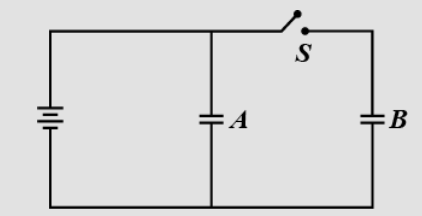
If three capacitors each of capacity 1μF are connected in such a way that the resultant capacity is 1.5 μF, then
|
(a) All the three are connected in series |
|
(b) All the three are connected in parallel |
|
(b) All the three are connected in parallel |
|
(d) Two of them are in series and then connected in parallel to the third |