In simple harmonic motion, the ratio of acceleration of the particle to its displacement at any time is a measure of
Easy


Download our appand get started for free
Experience the future of education. Simply download our apps or reach out to us for more information. Let's shape the future of learning together!No signup needed.*
Similar Questions
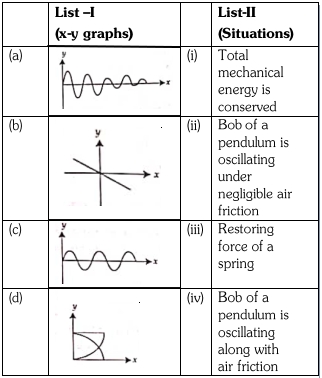
- 1Match $List - I$ with $List - II$View Solution
Choose the correct answer from the options given below
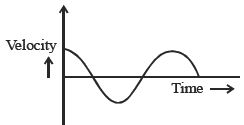
- 2View SolutionThe graph in figure represents
- 3At time $t = 0$, a simple harmonic oscillator is at its extreme position. If it covers half of the amplitude distance in $1\, second$, then the time period of oscillation is ..... $s$View Solution
- 4A mass $m$ attached to a spring oscillates every $2\, sec$. If the mass is increased by $2 \,kg$, then time-period increases by $1\, sec$. The initial mass is ..... $kg$View Solution
- 5Displacement-time equation of a particle executing $SHM$ is $x\, = \,A\,\sin \,\left( {\omega t\, + \,\frac{\pi }{6}} \right)$ Time taken by the particle to go directly from $x\, = \, - \frac{A}{2}$ to $x\, = \, + \frac{A}{2}$ isView Solution
- 6A particle moving along the $X-$axis executes simple harmonic motion, then the force acting on it is given byView Solution
Where $A$ and $K$ are positive constants
- 7View SolutionA simple pendulum is set into vibrations. The bob of the pendulum comes to rest after some time due to
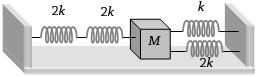
- 8Four massless springs whose force constants are $2k, 2k, k$ and $2k$ respectively are attached to a mass $M$ kept on a frictionless plane (as shown in figure). If the mass $M$ is displaced in the horizontal direction, then the frequency of oscillation of the system isView Solution
- 9A particle at the end of a spring executes simple harmonic motion with a period ${t_1}$, while the corresponding period for another spring is ${t_2}$. If the period of oscillation with the two springs in series is $T$, thenView Solution
- 10A particle of mass $m$ oscillates with simple harmonic motion between points ${x_1}$ and ${x_2}$, the equilibrium position being $O$. Its potential energy is plotted. It will be as given below in the graphView Solution