MCQ
In stationary waves, antinodes are the points where there is
  • A
    Minimum displacement and minimum pressure change
  • B
    Minimum displacement and maximum pressure change
  • C
    Maximum displacement and maximum pressure change
  • Maximum displacement and minimum pressure change
Answer

Correct option: D.
Maximum displacement and minimum pressure change
d
Antinodes are the points on stationary wave with maximum displacement and maximum pressure change.Nodes are the point of zero displacement of particle and here pressure is also minimum.Antonodes are shown in the given figure.

Need a full question paper?

Generate a complete, print-ready paper with questions like this in minutes — across 16+ boards, with answer keys.

Start Generating Free

Similar questions

A spinning wheel A is brought in contact with another wheel B, initially at rest. Because of the friction at contact, the second wheel also starts spinning. Which of the following energies of the wheel B increases?
  1. Kinetic.
  2. Total.
  3. Mechanical.
  4. Internal.
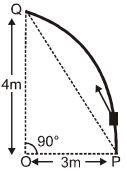
Consider an elliptically shaped rail $P Q$ in the vertical plane with $O P=3 \ m$ and $OQ =4 \ m$. A block of mass $1 \ kg$ is pulled along the rail from $P$ to $Q$ with a force of $18 \ N$, Which is always parallel to line $PQ$ (see the figure given). Assuming no frictional losses, the kinetic energy of the block when it reaches $Q$ is $(n \times 10)$ joules. The value of $n$ is (take acceleration due to gravity $=10 \ ms ^{-2}$ )
A ball is thrown upwards. It takes $4\,sec$ to reach back to the ground. Its initial velocity is........$ms^{-1}$
Velocity of a particle moving in a curvilinear path in a horizontal $X$ $Y$ plane varies with time as $\vec v = (2t\hat i + t^2 \hat j) \ \  m/s.$ Here, $t$ is in second. At $t = 1\  s$
Reynold's number (Re) can be defined as:
Two satellites of equal mass are revolving around earth in elliptical orbits of different semi-major axis. If their angular momenta about earth centre are in the ratio $3: 4$ then ratio of their areal velocity is ........
A balloon of mass $M$ is descending at a constant acceleration $\alpha $. When a mass $m$ is released from the balloon it starts rising with the same acceleration $\alpha $. Assuming that its volume does not change, what is the value of $m$ ?
The equation of $SHM$ of a particle is given as

$2\,\frac{{{d^2}x}}{{d{t^2}}} + 32x = 0$

where $x$ is the displacement from the mean position of rest. The period of its oscillation (in seconds) is

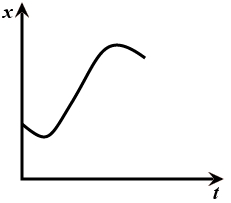
The accompanying graph of position $x$ versus time $t$ represents the motion of a particle. If $p$ and $q$ are both positive constants, the expression that best describes the acceleration $a$ of the particle is
The relative velocity of two consecutive layers is 8 cm/s. If the perpendicular distance between the layers is $0.1\, cm$, then the velocity gradient will be ......... $sec^{-1}$