MCQ
Reynold's number (Re) can be defined as:
  • A
    $\frac{\rho\eta}{\text{vd}}$
  • B
    $\frac{\text{vd}}{\rho}$
  • C
    $\frac{\rho\text{vd}}{\eta\text{d}}$
  • D
    $\text{d}\rho\frac{\text{v}}{\eta}$

Answer

  1. $\text{d}\rho\frac{\text{v}}{\eta}$

Need a full question paper?

Generate a complete, print-ready paper with questions like this in minutes — across 16+ boards, with answer keys.
Start Generating Free

Similar questions

In one average-life:
  1. Half the active nuclei decay.
  2. Less than half the active nuclei decay.
  3. More than half the active nuclei decay.
  4. All the nuclei decay.
A block of mass $m$ is placed on a smooth horizontal surface. A force making an angle $\theta$ with the horizontal starts acting on the block. The magnitude of the force is constant but its direction with the horizontal changes as $\theta = a+ bs$, where $a$ and $b$ are constants and $s$ is the distance covered by the block. If $|F| = 2mb$, find the velocity of the block as function of the angle $\theta$ .
A ball is thrown up at an angle with the horizontal. Then, the total change of momentum by the instant it returns to the ground is
At shallow depth $h$, the pressure in the ocean is simply given by $P = P_0 + \rho gh$, in which $\rho$ is the density of water and $P_0$ is the air pressure. As we go deeper, the high pressure causes the water to compress and become denser. Which of the following sketches illustrates the correct dependence of the pressure on the depth $h$ ?
A cork is submerged in water by a spring attached to the bottom of a pail. When the pail is kept in a elevator moving with an acceleration downwards, the spring length
A rod of length $l$ and radius $r$ is joined to a rod of length $l/2$ and radius $r/2$ of same material. The free end of small rod is fixed to a rigid base and the free end of larger rod is given a twist of $\theta°$, the twist angle at the joint will be
Velocity - time graph of a body with uniform velocity is a straight line:
A body of mass $m$ kg. starts falling from a point $2R$ above the Earth’s surface. Its kinetic energy when it has fallen to a point $‘R’$ above the Earth’s surface [$R-$Radius of Earth, $M-$Mass of Earth, $G-$Gravitational Constant]
The rate of change of velocity of an object with respect to time is called ..........
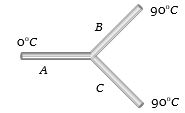
Three rods made of the same material and having the same cross section have been joined as shown in the figure. Each rod is of the same length. The left and right ends are kept at ${0^o}C$ and ${90^o}C$ respectively. The temperature of the junction of the three rods will be ...... $^oC$