Question
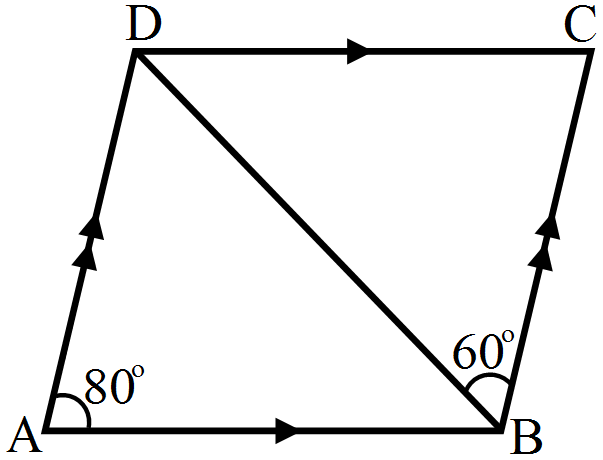
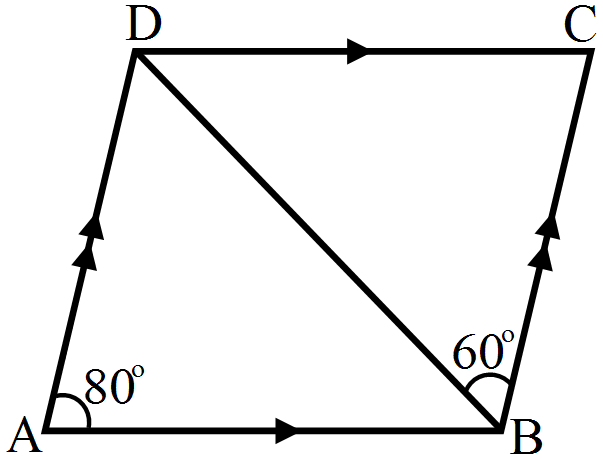
In the adjoining figure, ABCD is a parallelogram in which $\angle\text{DAB}=80^{\circ}$ and $\angle\text{DBC}=60^{\circ}.$ Calculate $\angle\text{CDB}$ and $\angle\text{ADB}.$
Answer


ABCD is a parallelogram,
so opposite angles are equal.
$\therefore\angle\text{C}=\angle\text{A}=80^{\circ}$
As AD || BC and BD is a transversal.
So, $\angle\text{ADB}=\angle\text{DBC}=60^{\circ}$ [Alternate angles]
In $\triangle\text{ABD}$
$\angle\text{A}+\angle\text{ADB}+\angle\text{ABD}=180^{\circ}$
$\Rightarrow80^{\circ}+60^{\circ}+\angle\text{ABD}=180^{\circ}$
$\Rightarrow140^{\circ}+\angle\text{ABD}=180^{\circ}$
$\Rightarrow\angle\text{ABD}=180^{\circ}-140^{\circ}=40^{\circ}$
$\therefore\angle\text{ABC}=\angle\text{ABD}+\angle\text{DBC}$
$=40^{\circ}+60^{\circ}=100^{\circ}$
In a parallelogarm, opposite angles are equal.
So, $\angle\text{ADC}=\angle\text{ABC}=\angle100^{\circ}$
$\therefore\angle\text{CDB}=\angle\text{ADC}-\angle\text{ADB}$
$=100^{\circ}-60^{\circ}=40^{\circ}$
and $\angle\text{ADB}=60^{\circ}.$

Need a full question paper?

Generate a complete, print-ready paper with questions like this in minutes — across 16+ boards, with answer keys.
Start Generating Free

Similar questions

In the adjoining figure, O is the centre of a circle. If AB and AC are chords of the circle such that AB = AC, $\text{OP}\perp\text{AB}$ and $\text{OQ}\perp\text{AC},$
prove that PB = QC.

Express $0.6+0.\overline7+0.4\overline7$ in the form $\frac{\text{p}}{\text{q}},$ where p and q are integers and $\text{q}\neq0.$
Find the value of p for the follwoing frequency distribution whose mean is 16.6.
x
8
12
15
p
20
25
30
f
12
16
20
24
16
8
4
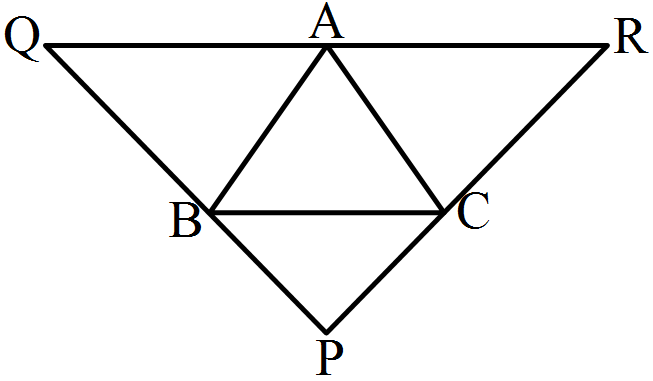
$\triangle\text{ABC}$ is given. If lines are drawn through A, B, C, parallel respectively to the sides BC, CA and AB, forming $\triangle\text{PQR},$ as shown in the adjoining figure, show that $\text{BC}=\frac{1}{2}\text{QR}.$

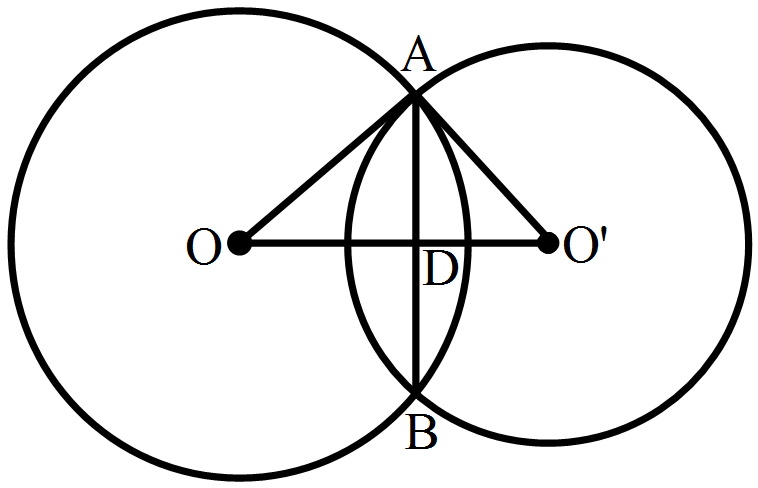
Two circles of radii 10cm and 8cm intersect each other, and the length of the common chord is 12cm. Find the distance between their centres.

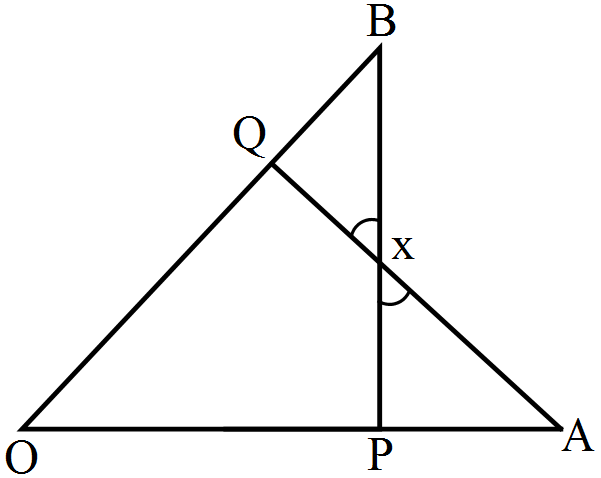
In the given figure, OA = OB and OP = OQ. Prove that (i) PX = QX, (ii) AX = BX.

In the adjoining figure, chords AC and BD of a circle with centre O, intersect at right angles at E. If $\angle\text{OAB}=25^\circ,$ calculate $\angle\text{EBC}.$

In a quadrilateral ABCD, show that
(AB + BC + CD + DA) <2 (BD + AC).
Draw the graph of the lines 2x + y = 6 and 2x - y + 2 = 0. Shade the region bounded by these lines and the x-axis. Find the area of the shaded region.
The sides of a quadrilateral ABCD taken in order are 6cm, 8cm, 12cm and 14cm respectively and the angle between the first two sides is a right angle. Find its area. $\big(\text{Given},\sqrt{6}=2.45\big)$