Question
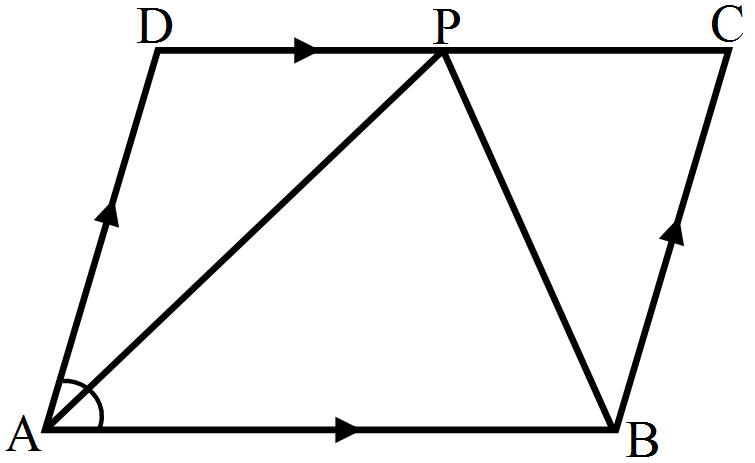
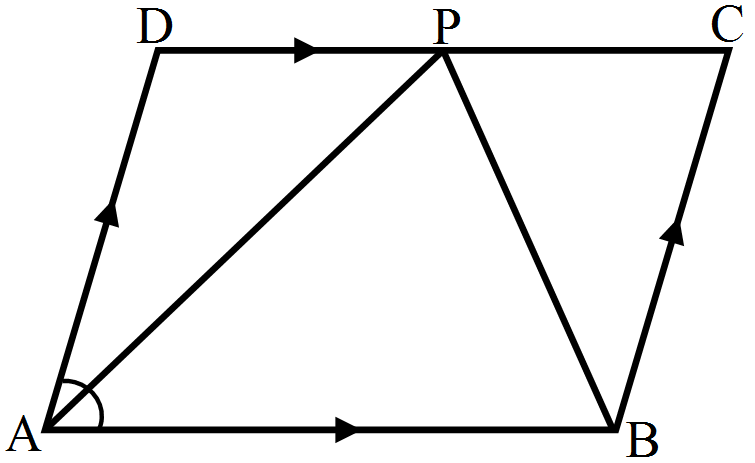
In the adjoining figure, $\text{ABCD}$ is a parallelogram in which $\angle\text{A}=60^{\circ}.$ If the bisectors of $\angle\text{A}$ and $\angle\text{B}$ meet $DC$ at $P$, prove that
$i. \angle\text{APB}=90^{\circ},$
$ii. AD = DP$ and $PB = PC = BC$,
$iii. DC = 2AD$.
Answer


$\text{ABCD}$ is a parallelogram in which $DA = 60^\circ$ and bisectore of $A$ and $B$ meets $DC$ at $P$.
$i.$ In a parallelogram, opposite angles are equal.
So, $\angle\text{C}=\angle\text{A}=60^{\circ}$
In a parallelogram the sum of all the four angles is $360^\circ $
$\Rightarrow\angle\text{A}+\angle\text{B}+\angle\text{C}+\angle\text{D}=360^{\circ}$
Now, $\angle\text{B}+\angle\text{D}=360^{\circ}-(\angle\text{A}+\angle\text{C})$
$=360^{\circ}-(60^{\circ}+60^{\circ})=240^{\circ}$
$\therefore2\angle\text{B}=240^{\circ}$ $[\because\angle\text{B}=\angle\text{D}]$
So, $\angle\text{B}=\angle\text{D}=\frac{240^{\circ}}{2}=120^{\circ}$
Since $AB\ \|\ DP$ and $AP$ is a transversal
SO, $\angle\text{APD}=\angle\text{PAB}=\frac{60^{\circ}}{2}=30^{\circ}...(1)[\therefore$ alternate angles$]$
Also, $AB\ \|\ PC$ and $BP$ is a transversal.
So, $\angle\text{ABP}=\angle\text{CPB}$
But, $\angle\text{ABP}=\frac{\angle\text{B}}{2}=\frac{120^{\circ}}{2}=60^{\circ}$
$\therefore\angle\text{CPB}=60^{\circ}...(2)$
Now, $\angle\text{APD}+\angle\text{APB}+\angle\text{CPB}=180^{\circ} [$As $\text{DPC}$ is a straight line$]$
$30^{\circ}+\angle\text{APB}+60^{\circ}=180^{\circ}$
$\Rightarrow\angle\text{APB}=180^{\circ}-30^{\circ}-60^{\circ}=90^{\circ}$
$ii.$ Since $\angle\text{APD}=30^{\circ} [$from $(1)]$
and $\angle\text{DAP}=\frac{60^{\circ}}{2}=30^{\circ}$
So, $\angle\text{APD}=\angle\text{DAP}$
Now in $\triangle\text{APD},$
$\angle\text{APD}=\angle\text{DAP}...(3)$
$\therefore\text{DP = AD} [$isosceles triangle, sides are equal$]$
As $\angle\text{CPB}=60^{\circ} [$from $(2)]$
and $\angle\text{C}=60^{\circ}$
So, $\angle\text{PBC}=180^{\circ}-60^{\circ}-60^{\circ}=60^{\circ}$
Since all angles in the $\triangle\text{PCB}$ are equal,
it is an equilateral triangle.
$\therefore\text{PB = PC = BC}...(4)$
$iii. \angle\text{DPA}=\angle\text{PAD}, [$from $(3)]$
$\therefore\text{DP = AD} [$isoscele striangle, sides are equal$]$
$=\text{BC} [$opposite sides are equal$]$
$=\text{PC} [$from $(4)]$
$=\frac{1}{2}\text{DC} [\because\text{DP = PC}\Rightarrow\text{P}$ is the midpoint of $DC]$
$\therefore\text{DC = 2AD.}$

Need a full question paper?

Generate a complete, print-ready paper with questions like this in minutes — across 16+ boards, with answer keys.

Start Generating Free

Similar questions

In a study of diabetic patients in a village, the following observations were noted.
Age in year
$10-20$
$20-30$
$30-40$
$40-50$
$50-60$
$60-70$
Number of patients
$2$
$5$
$12$
$19$
$9$
$4$
Represent the above data by a frequency polygon.
In $\triangle\text{ABC},$ if $3\angle\text{A}=4\angle\text{B}=6\angle\text{C},$ calculate $\angle\text{A},\angle\text{B}$ and $\angle\text{C}.$
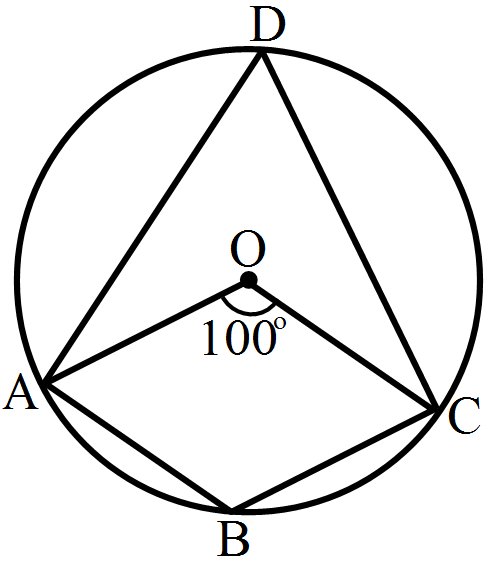
In the given figure, $O$ is the centre of the given circle and measure of arc $ABC$ is $100^\circ$. Determine $\angle\text{ADC}$ and $\angle\text{ABC}.$
Divide $p(x) by g(x)$, where $p(x) = x + 3x^2 – 1$ and $g(x) = 1 + x$
An umbrella is made by stitching $12$ triangular pieces of cloth, each measuring ($50cm \times 20cm \times 50cm$). Find the area of the cloth used in it.
The perimeter of an isoscale triangle is $32\ cm$. The ratio of the equal side to its base is $3 : 2$. Find the area of the triangle.
 Hint: Ratio of sides $= 3 : 3 : 2.$
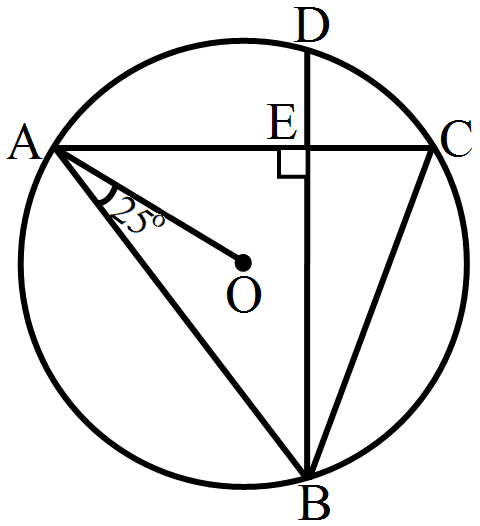
In the adjoining figure, chords $AC$ and $BD$ of a circle with centre $O$, intersect at right angles at $E$. If $\angle\text{OAB}=25^\circ,$ calculate $\angle\text{EBC}.$
Draw a histogram to represent the following data:
Class interval
$10-14$
$14-20$
$20-32$
$32-52$
$52-80$
Frequency
$5$
$6$
$9$
$25$
$21$
Verify the division algorithm for the polynomials $p(x) = 2x^4 - 6x^3 + 2x^2 - x + 2$ and $g(x) = x + 2.$
Consider the marks obtained by $10$ students in a mathematics test as given below:
$55, 36, 95, 73, 60, 42, 25, 78, 75, 62$
Find the maximum, minimum scores and range.