Question
✓
Answer
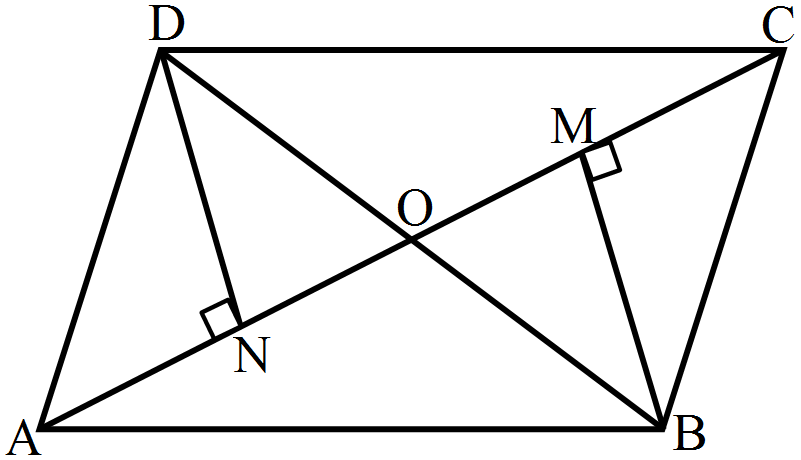
Given: A quadrilateral ABCD, in which $\text{BM}\perp\text{AC}$ and $\text{DN}\perp\text{AC}$ and BM = DN.
To prove: AC bisects BD; or DO = BO
Proof:
Let AC and BD intersect at O.
Now, in $\triangle\text{OND}$ and $\triangle\text{OMB},$ we have:
$\angle\text{OND}=\angle\text{OMB}$ (90° each)
$\angle\text{DON}=\angle\text{BOM}$ (Vertically opposite angles)
Also, $\text{DN = BM}$ (Given)
i.e., $\triangle\text{OND}\cong\triangle\text{OMB}$ (AAS congrurence rule)
$\therefore\text{OD = OB}$ (C.P.C.T.)
Hence, AC bisects BD.
To prove: AC bisects BD; or DO = BO
Proof:
Let AC and BD intersect at O.
Now, in $\triangle\text{OND}$ and $\triangle\text{OMB},$ we have:
$\angle\text{OND}=\angle\text{OMB}$ (90° each)
$\angle\text{DON}=\angle\text{BOM}$ (Vertically opposite angles)
Also, $\text{DN = BM}$ (Given)
i.e., $\triangle\text{OND}\cong\triangle\text{OMB}$ (AAS congrurence rule)
$\therefore\text{OD = OB}$ (C.P.C.T.)
Hence, AC bisects BD.
Need a full question paper?
Generate a complete, print-ready paper with questions like this in minutes — across 16+ boards, with answer keys.
Explore more
Similar questions
$\text{ABCD}$ is a parallelogram. $G$ is a point on $AB$ such that $AG = 2GB$ and $E$ is point on $DC$ such that $CE = 2DE$ and $F$ is the point of $BC$ such that $BF = 2FC$. Prove that:
$i. \text{ar}(\text{ADEG})=\text{ar}(\text{GBCE})$
$ii. \text{ar}{(\triangle\text{EGB}})=\frac{1}{6}\text{ar}(\text{ABCD})$
$iii. \text{ar}(\triangle\text{EFC})=\frac{1}{2}\text{ar}(\triangle\text{EBF})$
$iv. \text{ar}(\triangle\text{EBG})=\text{ar}(\triangle\text{EFC})$
$v.$ Find what portion of the parallelogram is the area of $\triangle\text{EFG}.$
→$i. \text{ar}(\text{ADEG})=\text{ar}(\text{GBCE})$
$ii. \text{ar}{(\triangle\text{EGB}})=\frac{1}{6}\text{ar}(\text{ABCD})$
$iii. \text{ar}(\triangle\text{EFC})=\frac{1}{2}\text{ar}(\triangle\text{EBF})$
$iv. \text{ar}(\triangle\text{EBG})=\text{ar}(\triangle\text{EFC})$
$v.$ Find what portion of the parallelogram is the area of $\triangle\text{EFG}.$
If each side of a triangle is doubled, the find percentage increase in its area.
The lengths of two parallel chords of a circle are $6\ cm$ and $8\ cm$. If the smaller chord is at a distance of $4\ cm$ from the centre, what is the distance of the other chord from the centre?
→Two chords AB, CD of lengths 5cm, 11cm respectively of a circle are parallel. If the distance between AB and CD is 3cm, find the radius of the circle.
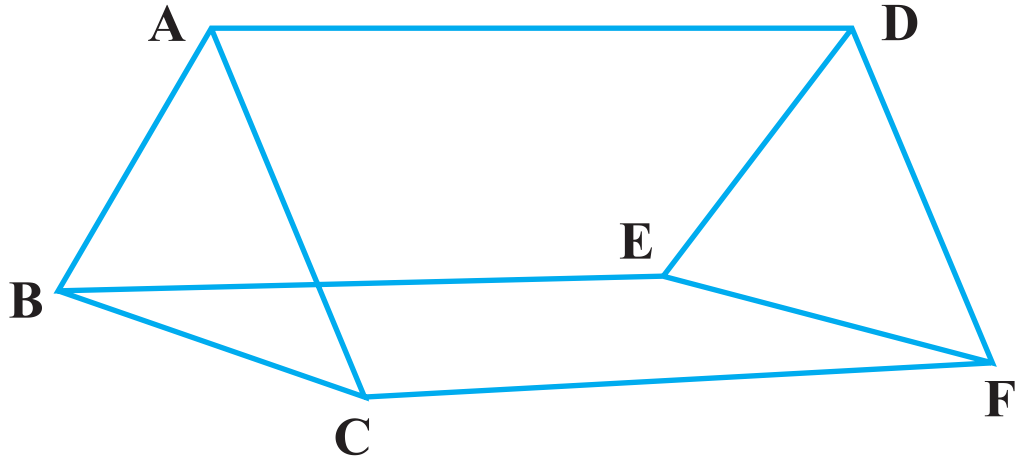
$AB || DE, AB = DE, AC || DF$ and $AC = DF.$ Prove that $BC || EF$ and $BC = EF.$
→Draw a line segment $AB$ bisect it. Bisect one of the equal parts to obtain a line segment of length $\frac{1}{2}(\text{AB})$
→The daily maximum temperatures (in degree Celsius) recorded in a certain city during the month of November are as follows: $25.8, 24.5, 25.6, 20.7, 21.8, 20.5, 20.6, 20.9, 22.3, 22.7, 23.1, 22.8, 22.9, 21.7, 21.3, 20.5, 20.9, 23.1, 22.4, 21.5, 22.7, 22.8, 22.0, 23.9, 24.7, 22.8, 23.8, 24.6, 23.9, 21.1$. Represent the data in the form of a frequency distribution table with class size $11^\circ\ C$.
→If each of the two lines is perpendicular to the same line, what kind of lines are they to each other?
In a rhombus $ABCD$ show that diagonal $AC$ bisects $\angle\text{A}$ as well as $\angle\text{C}$ and diagonal $BD$ bisects $\angle\text{B}$ as well as $\angle\text{D}.$
→In a $\triangle\text{ABC},$ D, E and F are, respectively the mid points of BC, CA and AB. If the lengths of sides AB, BC and CA are 7cm, 8cm and 9cm, respectively, find the perimeter of $\triangle\text{DEF}.$
→