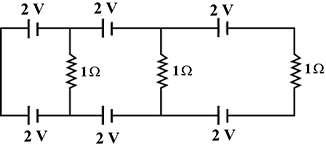
In the below circuit the current in each resistance is
JEE MAIN 2017, Easy


Download our appand get started for free
Experience the future of education. Simply download our apps or reach out to us for more information. Let's shape the future of learning together!No signup needed.*
Similar Questions
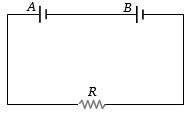
- 1Two batteries $A$ and $B$ each of $e.m.f.$ $2\, V$ are connected in series to an external resistance $R = 1 \,ohm$. If the internal resistance of battery $A$ is $1.9\, ohms$ and that of $B$ is $0.9\, ohm$, what is the potential difference between the terminals of battery $A$ ............. $V$View Solution
- 2A $10\,m$ long potentiometer wire has a potential gradient of $0.0025\, V/cm$. Calculate the distance of null point when the wire is connected to a $1.025\,V$ standard cell ............... $\mathrm{m}$View Solution
- 3Masses of three wires of copper are in the ratio of $1 : 3 : 5$ and their lengths are in the ratio of $5:3:1.$ The ratio of their electrical resistances areView Solution
- 4A letter $'A'$ is constructed of a uniform wire with resistance $1.0\,\Omega $ per $cm$ , The sides of the letter are $20\, cm$ and the cross piece in the middle is $10\, cm$ long. The apex angle is $60$ . The resistance between the ends of the legs is close to ................ $\Omega$View Solution
- 5View SolutionOhm's law fails in
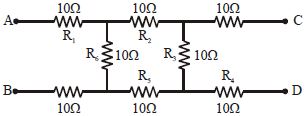
- 6The equivalent resistance between the points $A$ and $D$ ................ $\Omega$View Solution
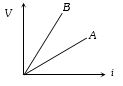
- 7$V-i$ graphs for parallel and series combination of two identical resistors are as shown in figure. Which graph represents parallel combinationView Solution
- 8A $220\, volt$ and $800\, watt$ electric kettle and three $220\, volt$ and $100\, watt$ bulbs are connected in parallel. On connecting this combination with $220\, volt$ electric supply, the total current will be ................ $ampere$View Solution
- 9Two cells of same emf but different internal resistances $I_{1}$ and $I_{2}$ are connected in series with a resistance $R$. The value of resistance $R$, for which the potential difference across second cell is zero, isView Solution
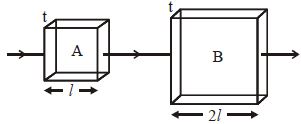
- 10Two square metal plates $A$ and $B$ are of the same thickness and material. The side of $B$ is twice that of $A$. These are connected as shown in series. If the resistances of $A$ and $B$ are denoted by $R_A$ and $R_B,$ then $(R_A/R_B)$ isView Solution