Question
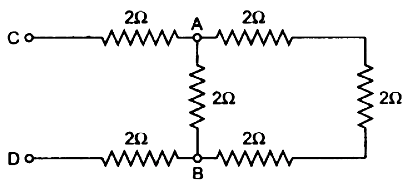
In the circuit shown below, calculate the equivalent resistance between the points (i) A and B, (ii) C and D.

Answer


(i) Between the points A and B : Three resistance 2 Ω, 2Ω, 2Ω are in series.
The equivalent resistance R' = 2 + 2 + 2 = 6 Ω
This is joined in parallel with a resistance 2Ω
The equivalent resistance $R=\frac{2 \times 6}{2+6}=\frac{12}{8}=15 . \Omega$
(ii) Between the points C and D:
The above combination of equivalent resistance 1.5 Ω is in series with two resistances 2Ω and 2Ω
Total effective resistance between the points C and D is R
= 1.5 + 2 + 2 = 5.5

Need a full question paper?

Generate a complete, print-ready paper with questions like this in minutes — across 16+ boards, with answer keys.
Start Generating Free

Similar questions

The diagram in Fig. 9.27 shows a three pin plug. Label the three pins.
(a) why if the top pin thicker and longer than the other two?
(b) why are the pins splitted at the ends?
A convex lens produces an image on a screen twice the size of the object. The distance between the object and screen is 45 cm. Find the distance of the lens from the object and its focal length by drawing a ray diagram.
In fission of one uranium - $235$ nucleus, the loss in mass is $0.2$ a.m.u. Calculate the energy released.
Copy the given diagram of a transformer and complete it. Name the parts A and B. Name the part you have drawn to complete the diagram. What is the material of this part? Is this transformer a step-up or step-down? Give reason.
Why is it easier to open a door by applying the force at the free end of it?
Describe the construction and working of a filament lamp. List the material used and state why they are suitable for their purpose in this lamp.
(i) (a) Find the equivalent resistance between A and B .
(b) State whether the resistivity of a wire changes with the change in the thickness of the wire.
(ii) (a) Write down differences between resistance and specific resistance.
(b) What does the slope of a V-I graph for a conductor represent.
(c) A corrent of 0.2 A flows through a conductor of resistance $4.5 \Omega$ Calculate the p.d. at the ends of the conductor.
Image
(iii) (a) Derive an expression for the current (I), when $n$ cells each of emf (E) and the internal resistance ( $r$ ) are connected in series to an external resistance $R$.
(b) State two conditions necessary to have maximum current in the external circuit when the cells are connected in series.
Four resistances of 2.0Ω each are joined end to end, to form a square ABCD. Calculate the equivalent resistance of the combination between any two adjacent comers.
Draw a diagram of a single fixed pulley and obtain expressions for its:
(i) Mechanical advantage,
(ii) Velocity ratio, and
(iii) Efficiency, in the ideal case.
Differentiate between the following:
Light and sound waves.