Questions

[5 Mark Question Answer]

🎯

Test yourself on this topic

40 questions · timed · auto-graded

Question 15 Marks
Two bulbs are marked $100 W, 220 V$ and $60 W, 110 V$. Calculate the ratio of their resistances.
Answer
Given $I^{st}$ Bulb
$P_1 = 100 W$
$V_1 = 220 V$
$II^{nd}​​​​​​​$ Bulb
$P_2 = 60 W$
$V_2 = 110V$
We know $P=\frac{V^2}{R}$
So $R=\frac{V^2}{P}$
So $\frac{ R _1}{ R _2}=\frac{\frac{ V _1^2}{ P _1}}{\frac{ V _2^2}{ P _2}}$
$=\frac{ V _1^2 \times P _2}{ P _1 \times V _2^2}$
$=\frac{220^2 \times 60}{100 \times 110 \times 110}=2.4$
View full question & answer
Question 25 Marks
A cell supplies a current of $0.6 A$ through a $2Ω$ coil and a current of $0.3$ A through on $8Ω $ coil. Calculate the e.m.f and internal resistance of the cell.
Answer
Given: $I _1=0.6 A, R _1=2 \Omega$ and $I _2=0.3 A, R _2=8 \Omega$
Let the e.m.f. of the cell is $E$ and its internal resistance is $r$.
From $I=\frac{E}{R+r}$
$0.6=\frac{E}{2+r}$ and $0.3=\frac{E}{8+r}$
$\therefore E=0.6(2+r)=1.2+0.6 r$ and
$E=0.3(8+r)=2.4+0.3 r$
Thus, $1.2+0.6 r=2.4+0.3 r$
or $0.6 r-0.3 r=2.4-1.2$
Or $0.3 r=1.2$ or
$r=\frac{1.2}{0.3}=4 \Omega$
and $E=1.2+0.6 \times 4=1.2+2.4=3.6 V$
View full question & answer
Question 35 Marks
What is an Ohmic resistor?
Answer
Ohmic resistors: The resistors which obey Ohm's law are called ohmic resistors or linear resistances.

Eg: all metallic conductors like silver, aluminium, etc. For such resistors, a graph plotted for the potential difference V against current I is a straight line and the value of resistance R is the same irrespective of the value of V or I.

i.e. V ∝ I
V = IR at constant temperature.

View full question & answer
Question 45 Marks
What is the purpose of fuse in an electrical circuit?
Answer
An electric fuse is a device which is used to Ii m it the current in an electric circuit. The use of a fuse thus safeguards the circuit and appliances connected in that circuit from being damaged. It is a short piece of wire made of an alloy of lead and tin. If the current passing through the fuse exceeds the safeguard Ii m it the heat produced melts the fuse and this breaks the circuit.
View full question & answer
Question 55 Marks
State two dis-similarities and one similarity between a d.c. motor and an a.c. generator.
Answer
Two dissimilarities between D.C. motor and A.C. generator:
A.C. Generator D.C. Motor
1. A generator is a device which converts mechanical energy into electrical energy. 1. A D.C. motor is a device which converts electrical energy into mechanical energy.
2. A generator works on the principle of electromagnetic induction. 2. A D.C. works on the principle of force acting on a current carrying conductor placed in a magnetic field.
Similarity: Both in A.C generator and D.C motor, a coil rotates in a magnetic field between the pole pieces of a powerful electromagnet.
View full question & answer
Question 65 Marks
State the limitations of Ohm’s law.
Answer
There are two main limitations:
(i) Temperature,
(ii) Physical condition of the conductor.

It is found that the ratio V/I is mo longer constant when the temperature is not kept constant. Generally, resistance increases with the rise in the temperature of the conductor.
Physical conditions of any conductor mainly include:
(i) Its length,
(ii) Its cross-sectional area,
(iii) The kind of material.

If there is no change in any of the above three conditions and also other condition like temperature remains constant, then Ohm’s law holds good, i.e., the ratio V/I remains constant.

View full question & answer
Question 75 Marks
Two copper wires are of the same length, but one is thicker than the other.
  1. Which wire will have more resistance?
  2. Which wire will have more specific resistance?
Answer
(1)
We know that,
$R =\rho \frac{l}{A}$
Where, $\rho =$ specific resistance
$L =$ length of wire
$A =$ area of cross-section
let the area of the cross-section of the wires be $A_1 & A_2$. It is said that one is thicker than the other.
So $A_1 > A_2​​​​​​​$​​​​​​​
When the length of the wire is given to be the same
then we can see that $R \propto \frac{1}{A}$.
So, the wire with less area of the cross-section will have more resistance.
(2) We know that the specific resistance$(\rho )$ does not depend on the length or thickness of the wire. It depends upon the material used. It will be the same in this case.
View full question & answer
Question 85 Marks
How does the resistance of a metallic wire depend on its temperature? Explain with reason.
Answer
With the increase in temperature of conductor, both the random motion of electrons and the amplitude of vibration of fixed positive ions increase. As a result, the number of collisions increases. Hence, the resistance of a conductor increases with the increase in its temperature. The resistance of filament of a bulb is more when it is glowing (i.e., when it is at a high temperature) as compared to when it is not glowing (i.e., when it is cold).
View full question & answer
Question 95 Marks
How does the resistance of a metallic wire depend on its temperature? Explain with reason.
Answer
With the increase in temperature of conductor, both the random motion of electrons and the amplitude of vibration of fixed positive ions increase. As a result, the number of collisions increases. Hence, the resistance of a conductor increases with the increase in its temperature. The resistance of filament of a bulb is more when it is glowing (i.e., when it is at a high temperature) as compared to when it is not glowing (i.e., when it is cold).
View full question & answer
Question 105 Marks
On what factors does the resistance of a conductor depend?
Answer
Factors on which the resistance of a conductor depends:
  1. Length of conductor: Resistance is directly proportional to the length of the conductor. This means Resistance increases with an increase in the length of the conductor. This is the cause that long electric wires create more resistance to the electric current.
  2. Area of cross-section: Resistance is inversely proportional to the area of the cross-section of the conductor. This means Resistance will decrease with an increase in the area of the conductor and vice versa. This is the cause that thick copper wire creates less resistance to the electric current.
  3. Temperature: Resistance is directly proportional to the temperature.
  4. Nature of material: Some materials create the least hindrance and hence are called good conductors. Silver is the best conductor of electricity. While some other materials create more hindrance in the flow of electric current, i.e. flow of electrons through them. Such materials are called bad conductors. Bad conductors are also known as insulators. The hard plastic is one of the best insulators of electricity.
View full question & answer
Question 115 Marks
Point out two differences between e.m.f. and potential difference as applied to electric circuits.
Answer
Electromotive force or e.m.f. of a cell is potential difference between its two electrodes when it is in open circuit, i.e., not sending current in the external circuit; while potential difference is the difference in potential between the terminals when the cell is in closed circuit or it is sending current in the given circuits, e.m.f. is always greater than potential difference or terminal voltage of a cell on account of energy being spent in driving charge through the circuit.
View full question & answer
Question 125 Marks
State and define Ohm’s law.
Answer
Ohm’s law states that at a constant temperature, the current flowing in a conductor is directly proportional to the potential difference across its ends, i.e., if the potential difference is halved, the current is also halved and if p.d. is doubled, the current is also doubled, i.e.,
V (potential difference) ∝ i (current)
Or V = iR, where R is constant, called the resistance of the conductor.
So V = iR represents Ohm’s law.
View full question & answer
Question 135 Marks
When a resistance of 3Ω is connected across a cell, the current flowing is 0.5 A. On changing the resistance to 7Ω, the current becomes 0.25A. Calculate the e.m.f. and the internal resistance of the cell.
Answer
$I=\frac{E}{R+r}$
$\therefore 0.5=\frac{ E }{3+ r } \quad \ldots .($ as I $=0.5 A$ when $R =3 \Omega)$
∴ E = (3 + r) × 0.5 ....(i)
also $0.25=\frac{E}{7+r} \quad \ldots($ as I $=0.25 A$ when $R =7 W )$
∴ E = (7 + r) × 0.25 ....(ii)
Comparing equation (i) and (ii)
E = (3 + r) × 0.5
= (7 + r) × 0.25
∴ 1.5 + 0.5r = 1.75 + 0.25r
∴ 0.25 r = 0.25
Internal resistance = r = 1 Ω
Now E = I (R + r)
∴ E = 0.5(3 + 1) (as I = 0.5 A when R = 3 Ω, r = 1 Ω)
∴ E = 0.5 + 1.5 = 2 V
E.m.f. of cell E = 2 volt = 2 V.
View full question & answer
Question 145 Marks
Three resistances, of which two are equal when connected in series have an effective resistance of $30$ ohms. When the three resistances are connected in parallel, the effective resistances is $3$ ohms. Find the values of the individual resistances.
Answer
When connected in series, $R = R_1 + R_1 + R_2$ (two are equal)
$R = 2R_1 + R_2$
$\therefore 2R_1 + R_2 = 30 ....(R = 30 \Omega )$
$\therefore 2R_1 = 30 - R_2$
$\therefore R _1=\frac{30- R }{2} \quad \ldots .$. (i)
When connected in parallel,
$\frac{1}{ R }=\frac{1}{ R _1}+\frac{1}{ R _1}+\frac{1}{ R _2}$
Or $\frac{1}{ R }=\frac{1}{\frac{30- R _2}{2}}+\frac{1}{\frac{30- R _2}{2}}+\frac{1}{ R _2}$ ....(From equation (i))
$\therefore \frac{1}{ R }=\frac{2}{30- R _2}+\frac{2}{30- R _2}+\frac{1}{ R _2}$
$\frac{1}{3}=\frac{4}{30- R _2}+\frac{1}{ R _2} \quad \ldots($ as $R =3 \Omega)$
$\therefore \frac{1}{3}=\frac{4 R _2+30- R _2}{ R _2\left(30- R _2\right)}=\frac{3 R _2+30}{ R _2\left(30- R _2\right)}$
$\therefore R _2 \frac{30- R _2}{3}=9 R _2+90$
$30 R _2- R _2^2=9 R _2+90$
$R _2^2-21 R _2+90=0$
$\therefore R_2 - 6R_2- 15R_2 + 90 = 0$
$\therefore R_2 = 6$ or $15$
$\therefore R _1=\frac{30-6}{2}$ or $\frac{30-15}{2}$
$R_1= 12 \Omega $ or $7.5 \Omega$
The three resistances can have values $12 \Omega , 12 \Omega $ and $6 \Omega $ or $15 \Omega , 7.5 \Omega $ and $7.5 \Omega .​​​​​​​$
View full question & answer
Question 155 Marks
A cell of e.m.f. $1.5 V$ and internal resistance $1.0 W$ is connected to two resistors of $4.0 W$ and $20.0$ in series as shown in the figure: Calculate the:(i) Current in the circuit.
(ii) Potential difference across the $4.0$ ohm resistor.
(iii) Voltage drop when the current is flowing.
(iv) Potential difference across the cell.
Answer
E.m.f. of cell $= 1.5$ volt, Internal resistance $= 1.0 ohm$
External resistance $= r_1 + r_2$ (in series) $4 + 20 \ 24 \Omega$
current $(I)=\frac{E}{r+R}$ or $I=\frac{1.5}{1+24}=\frac{1.5}{25}$
$= 0.06 Amp.$
(ii) $\therefore$ P.D. across $4 \Omega$ resistor $= r_1I = 4 \times 0.06 = 0.24$ volt
(iii) Voltage drop $= Ir = 0.06 \times 1 = 0.06$ volt
(iv) $\therefore$ Potential across cell $= RI = 24 \times 0.06$
$= 1.44 volt$
View full question & answer
Question 165 Marks
State and explain the laws of resistance.
Answer
The following are the main laws of resistance:<br>(i) Resistance of a conductor is directly proportional to its length, provided temperature and other physical conditions remain unchanged.<br>It means that R ∝ l i.e., if the length increases, the resistance also increases and if length decreases, its resistance also decreases.<br>(ii) Resistance of a conductor is inversely proportional to its area of cross section, other conditions remaining the same.<br>If A is the area of cross section, then:<br>$R \alpha \frac{1}{ A }$<br>or $\quad R \propto \frac{1}{\pi r ^2}$<br>where r is the radius of the wire<br>Keeping the length same, if the radius of the wire is doubled then:<br>$R \alpha \frac{1}{(2 r )^2} \alpha \frac{1}{4 r ^2}$<br>or $R \propto \frac{1}{4} \cdot \frac{1}{\pi r ^2}$, or $R$ becomes one fourth.<br>Similarly if r is made half, then:<br>$R \alpha \frac{1}{\left(\frac{ r }{2}\right)^2}$<br>$\alpha \frac{4}{ r ^2} \alpha 4\left(\frac{1}{ r ^2}\right)$, orR becomes 4 times<br>This shows that $R$ is $\alpha \frac{1}{A}$<br>(iii) R depends on the nature of the material of the conductor. It means, if we take equal lengths of wires of copper, aluminium and iron and all of the same cross-sectional area, their resistance are different from each other since they are of different materials.
View full question & answer
Question 175 Marks
What is a resistance? Define it with respect to Ohm’s law,
Answer
In the flow of current in a conductor, electrons are drifted. During this drift or flow, electrons mutually collide against each other and the atoms of the conductor. These collisions give rise to some obstruction to the flow of electrons. This opposition or obstruction offered by a conductor to the flow of electrons is called ‘Resistance’. According to Ohm’s law, the ratio between potential difference V and the current i, is a constant provided the temperature and physical conditions of the conductor remain unaltered. As such the ratio V/I is called the resistance, i.e., ‘Ohmic resistance’ of the conductor.
View full question & answer
Question 185 Marks
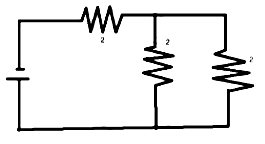
Three resistors each of $2\Omega $ are connected together so that their total resistance is $3\Omega $. Draw a diagram to show this arrangement and check it by calculation.
Answer
A parallel combination of two resistors, in series with one resistor.
$R_1 = 2$ ohm
$R_2= 2$ ohm
$R_3 = 2$ ohm
$\frac{1}{R}=\frac{1}{R_1}+\frac{1}{R_2}$
$\frac{I}{ R }=\frac{1}{2}+\frac{1}{2}=1$
$R = R + R _3=1+2=3 ohm$
View full question & answer
Question 195 Marks
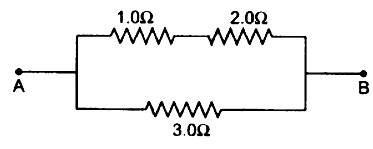
You are provided with three resistors of resistance 1.0 Ω, 2.0 Ω and 3.0 Ω How would you connect them to obtain the total effective resistance 1.5 Ω? Draw diagram of the arrangement and check it by calculations.
Answer

Two resistors of resistance 1.0 Ω and 2.0 Ω are connected in series and then this combination is connected in parallel with the resistor of resistance 3.0 Ω. The arrangement is shown in given figure alongside
Total resistance of series combination R = 1 + 2 = 3 Ω.
Total effective resistance of parallel combination
View full question & answer
Question 205 Marks
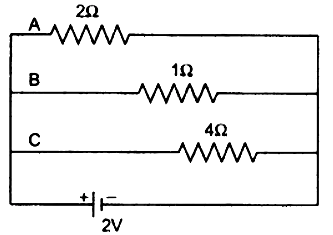
$2 \Omega$ resistor $A, 1 \Omega$ resistor $B$ and $4 \Omega$ resistor $C$ are connected in parallel. The combination is connected across a $2 V$ battery of negligible resistance. Draw the diagram of the arrangement and calculate:
(i) The current in each resistor $A$ and $C ,$
(ii) The current through battery.
Answer
The diagram of the arrangement is shown in given figure.

(i) The current in resistor $A$ is $I _1=\frac{ V }{ R _1}=\frac{2}{2}=1.0 A$
The current in resistor $B$ is $I _2=\frac{ V }{ R _2}=\frac{2}{1}=2.0 A$
The current in resistor $B$ is $I _3=\frac{ V }{ R _3}=\frac{2}{4}=0.5 A$
(ii) The current through battery
$I = I_1 + I_2 + I_3$
$I = 1.0 + 2.0 + 0.5$
$= 3.5$ Ampere.
View full question & answer
Question 215 Marks
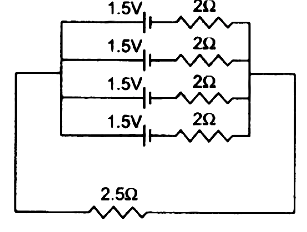
Four cells, each of e.m.f. 1.5 V and internal resistance 2.0 ohms are connected in parallel. The battery of cells is connected to an external resistance of 2.5 ohms. Calculate:
(i) The total resistance of the circuit.
(ii) The current flowing in the external circuit.
(iii) The drop in potential across-the terminals of the cells.
Answer
E.m.f. of cell (each) = 1.5 V. and also e.m.f. of all four cells = 1.5V, internal resistance of each cell = 2.0 ohm.

Total internal resistance of all four cells
$\frac{1}{ r ^1}=\frac{4}{ r }=\frac{4}{2.0}=2.0 ohm$
$\therefore r^1=\frac{1}{2}=0.5 ohm$
(i) ∴ Total resistance of circuit = R + r
= 2.5 + 0.5 = 3.0 ohm
(ii) Current flowing in the external circuit
$I =\frac{ E }{ r }=\frac{1.5}{2.5}=0.6 Amp$
(iii) The drop in potential across the terminals of the cells
$= I \times \frac{ r }{4}=0.6 \times \frac{2}{4}=0.6 \times 0.5=0.30$ Volt.
View full question & answer
Question 225 Marks
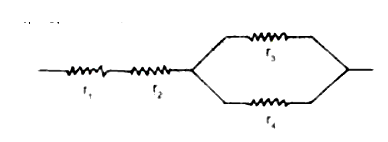
Calculate the equivalent resistance of the following combination of resistor $r_1, r_2, r_3$, and $r_4$
Answer
In the given network, the series combination of resistors, $r_1$ and $r_2$ is connected in series with the parallel combination of resistors, $r_3$ and $r_4$
Equivalent resistance of resistor $r_1$ and $r_2$ , Rs=$ r_1 + r_2$​​​​​​​
Equivalent resistance of resistor $r_3$ and $r_4R_p =$
$\left[\frac{1}{ r ^3}+\frac{1}{ r ^4}\right]^{-1}=\frac{ r _3 r _4}{ r _3+ r _4}$
equivalent resistance of the given network, $R = R_s​​​​​​​ +R_p=r_1+r_2+\frac{r_3 r_4}{r_3+r_4}$
View full question & answer
Question 235 Marks
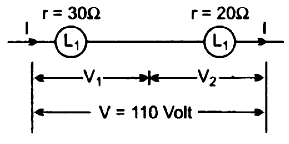
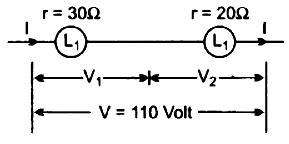
Two lamps of resistance $30Ω$ and $20Ω$ respectively are connected in series in a $110V$ circuit. Calculate:
(i) the total resistance in the circuit
(ii) the current in the circuit, and
(iii) the voltage drop across each lamp.
Answer

(i) Since the two lamps are connected in series, their total resistance R is given by:
$R = R_1 + R_2$
$= 30 \Omega + 20 \Omega = 50 \Omega$
(ii) We have, $V = 110$ volt, $R = 50 \Omega$
$\therefore$ By Ohm's law
$I=\frac{V}{R}=\frac{110}{50} A=2.2 A$
(iii) We now have
$I = 2.2 A$
$\therefore V_1 = IR_1 = 2.2 \times 30V = 66 V$
$\therefore$ Voltage frop across $L_1 = 66 V$
Similarly, $V_2 = IR_2 = 2.2 \times 20 = 44 V$
$\therefore$ Voltage drop across $L_2 = 44 V.$
View full question & answer
Question 245 Marks
Six equal resistors of $1$ ohm each are connected to form the sides of a hexagon $ABCDEF.$ Calculate the resistance offered by the combination if the current enters at A and leaves it at $D.$
Answer

(i) Since the two lamps are connected in series, their total resistance R is given by:
$R = R_1 + R_2$
$= 30 \Omega + 20 \Omega = 50 \Omega$
(ii) We have, $V = 110$ volt, $R = 50 \Omega$
$\therefore$ By Ohm's law
$I=\frac{V}{R}=\frac{110}{50} A=2.2 A$
(iii) We now have
$I=2.2 A$
$\therefore V_1=I R_1=2.2 \times 30 V=66 V$
$\therefore$ Voltage frop across $L_1=66 V$
Similarly, $V _2=1 R _2=2.2 \times 20=44 V$
$\therefore$ Voltage drop across $L _2=44 V$
View full question & answer
Question 255 Marks
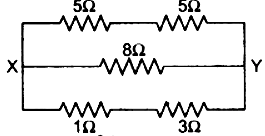
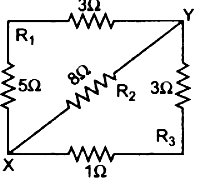
What is the equivalent resistance between the points $X$ and $Y$ for the given network?
Answer
An equivalent circuit for the combination


$\frac{1}{ R }=\frac{1}{ R _1}+\frac{1}{ R _2}+\frac{1}{ R _3}$
$R_1 = 5 + 3 = 8 \Omega$
$R_2 = 8 \Omega$
$R_3 = 1 + 3 = 4 \Omega$
$\frac{1}{ R }=\frac{1}{8}+\frac{1}{8}+\frac{1}{4}$
$\frac{1}{R}=\frac{1+1+2}{8}$
$=\frac{4}{8}=\frac{1}{2}$
$R = 2 \Omega$
View full question & answer
Question 265 Marks
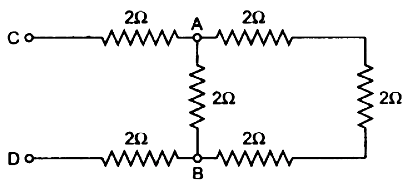
In the circuit shown below, calculate the equivalent resistance between the points (i) A and B, (ii) C and D.
Answer

(i) Between the points A and B : Three resistance 2 Ω, 2Ω, 2Ω are in series.
The equivalent resistance R' = 2 + 2 + 2 = 6 Ω
This is joined in parallel with a resistance 2Ω
The equivalent resistance $R=\frac{2 \times 6}{2+6}=\frac{12}{8}=15 . \Omega$
(ii) Between the points C and D:
The above combination of equivalent resistance 1.5 Ω is in series with two resistances 2Ω and 2Ω
Total effective resistance between the points C and D is R
= 1.5 + 2 + 2 = 5.5
View full question & answer
Question 275 Marks
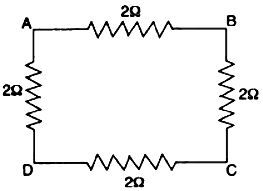
Four resistances of 2.0Ω each are joined end to end, to form a square ABCD. Calculate the equivalent resistance of the combination between any two adjacent comers.
Answer
The diagram indicates a square ABCD formed by joining four resistances of 2Ω each, end to end.
Let us calculate the equivalent resistance of the combination B between the two adjacent comets C and D.


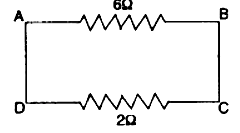
From given figure, arms DA, AB and BC are joined in series.
So, their equivalent of 6Ω and 2Ω are in parallel.
∴ The equivalent resistance of the combination is R.
Then, $\frac{1}{ R }=\frac{1}{6}+\frac{1}{2}=\frac{4}{6}=\frac{2}{3}$
$\therefore R =\frac{3}{2} \Omega$
= 1.5 Ω
View full question & answer
Question 285 Marks
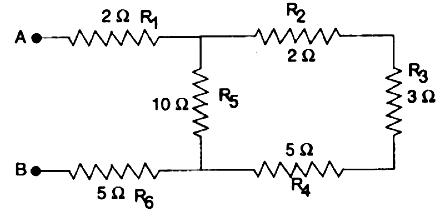
Six resistances are connected together as shown in the figure. Calculate the equivalent resistance between points A and B.
Answer
The resistors $R_2, R_3$ and $R_4$ in series.
$\therefore R' = R_2 + R_3 + R_4$
$= 2 + 3 + 5 = 10 \Omega$
Now $R^{\prime}$ and $R_5$ are in parallel.
$\therefore \frac{1}{ R \prime \prime}=\frac{1}{ R \prime}+\frac{1}{ R _5}$
$=\frac{1}{10}+\frac{1}{10}=\frac{2}{10}=\frac{1}{5}$
$\therefore R'' = 5 \Omega$
Now $R_1, R”$ and $R_6$ in series between the points $A$ and $B.$ The equivalent resistance between $A$ and $B$ is
$R = R_1+ R” + R_6 = 2 + 5 + 5 = 12 Ω$
View full question & answer
Question 295 Marks
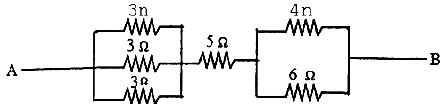
Find the equivalent resistance between points $A$ and $B$
Answer
As shown in the circuit diagram all the 3Ω resistors re connected in parallel.
$\frac{1}{R_1}=\frac{1}{3}+\frac{1}{3}+\frac{1}{3}$
$R_1=1 \Omega$
Resistors $4\Omega$ and $6\Omega $ are connected in parallel.
$\frac{1}{R_2}=\frac{1}{4}+\frac{1}{6}=\frac{5}{12}$
$R_2=\frac{12}{5} \Omega$
Now $R_1, R_2$​​​​​​​ and $5\Omega $ are connected in series
$R_{A B}=1+\frac{12}{5}+5$
$R_{A B}=\frac{42}{5}$
$R_{A B}=8.4 \Omega$
View full question & answer
Question 305 Marks
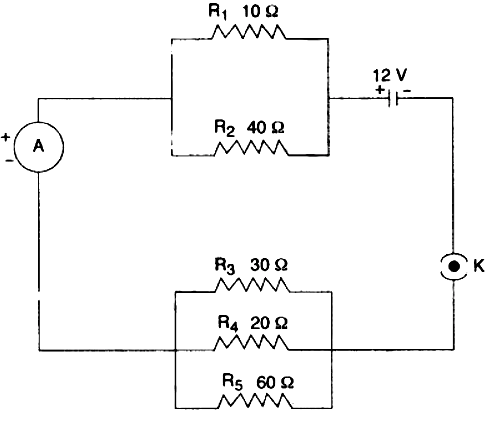
Five resistors of different resistances are connected together as shown in the figure. $A 12$ V battery is connected to the arrangement.

Calculate:
(i) the total resistance in the circuit
(ii) the total current flowing in the circuit.
Answer
(i) From given figure, $R_1$ and $R_2$ are parallel.
$\because \frac{1}{ R ^{\prime}}=\frac{1}{ R _1}+\frac{1}{ R _2}$
$=\frac{1}{10}+\frac{1}{40}=\frac{5}{40}=\frac{1}{8}$
$\therefore R' = 8 \Omega$
$R_3, R_4$ and $R_5 $are also parallel,
$\frac{1}{R^{\prime \prime}}=\frac{1}{R_3}+\frac{1}{R_4}+\frac{1}{R_5}$
$=\frac{1}{30}+\frac{1}{20}+\frac{1}{60}=\frac{6}{60}=\frac{1}{10}$
$\therefore R'' = 10 \Omega$
$\therefore$ Total resistance in the circuit
$= R' R'$
$= 8 + 10 = 18 \Omega$
(ii) V = 12 volt.
$\therefore$ Total current flowing in the circuit ]
$I=\frac{V}{R}=\frac{12}{18}$
$=\frac{2}{3}=0.667 A$.
View full question & answer
Question 315 Marks
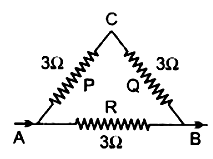
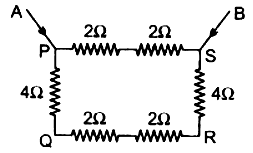
Calculate equivalent resistance in the following cases:

Answer
(i) Resistance P and Q are in series = 3 Ω + 3 Ω = 6 Ω
Resistance of 6 Ω segment and 3 Ω are parallel.
$\therefore \frac{1}{ R }=\frac{1}{6}+\frac{1}{3}=\frac{1+2}{6}=\frac{3}{6}$ or $R =2 \Omega$
(ii) Resistance of the arm PS = 2Ω +2Ω = 4Ω (in series)
Resistance of the arm QR = 2Ω + 2Ω = 4Ω (in series)
Resistance of the arm PQ, QR and RS are in series
= (4 + 4 + 4)Ω = 12Ω
Now resistance of the arm RS and arms (PQ + QR + RS) are in parallel.
$\frac{1}{ R }=\frac{1}{4}+\frac{1}{12}$
$=\frac{3+1}{12}=\frac{4}{12}$
or R = 3Ω
View full question & answer
Question 325 Marks
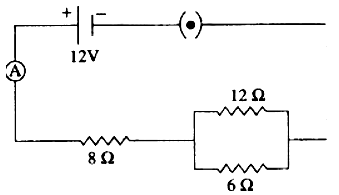
Three resistors are connected to a $12 \ V$ battery as shown in the figure given below:

(i) What is the current through the $8$ ohm resistor?
(ii) What is the potential difference across the parallel combination of $6$ ohm and $12$ ohm resistor?
(iii) What is the current through the $6$ ohm resistor?
Answer
(i) 6 ohm and 12 ohm are connected in parallel, So
$\Rightarrow \frac{1}{ R _1}=\frac{1}{6}+\frac{1}{12}=\frac{2+1}{12}=\frac{3}{12}$
$\Rightarrow \frac{1}{ R _1}=\frac{1}{4}$
$R_1 = 4$ ohm.
$\therefore$ Total Resistance $R = 8 + 4 = 12$ ohm.
Now $\because V = IR$
$\Rightarrow 12 = I \times 12$
$\therefore I = 1 Amp.$
$(ii) V = IR = 1 \times 4 = 4$ Volt
$(iii) \because V = I_1R$
$\Rightarrow 4 = I_1\times 6$
$\therefore l _1=\frac{4}{6}$
$= 0.66$ Amp.
View full question & answer
Question 335 Marks
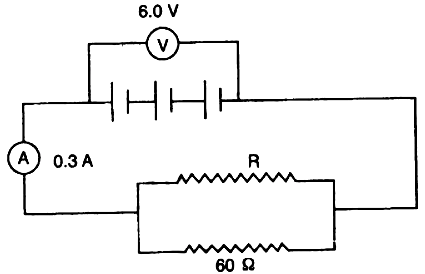
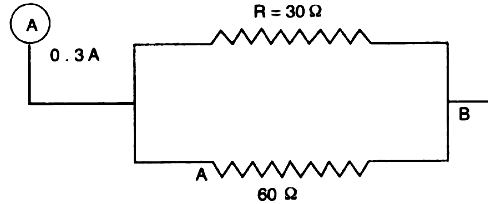
In the figure below, the ammeter A reads $0.3 A$. Calculate:
(i) the total resistance of the circuit
(ii) the value of $R$
(iii) the current flowing through$ R.$
Answer
$(i) \because V = IR$
$\therefore R =\frac{ V }{ I }=\frac{6.0}{0.3}=20 \Omega$
(ii) Total resistance = 20 Ω
$\because$ Resistance in parallel
$\therefore \frac{1}{20}=\frac{1}{R}+\frac{1}{60}$
$\frac{1}{R}=\frac{1}{20}-\frac{1}{60}$
$\frac{1}{ R }=\frac{3-1}{60}$
$R=\frac{60}{2}=30 \Omega$
(iii) $\because V = IR$
and potential $(V)$ is equal at the two ends i.e. $A$ and $B$

Let $I_1$​​​​​​​ be current flowing through $R$
$\therefore (0.3 - I_1)$ is current flowing through $60 \Omega $ resistance.
Now $V = V$
$\Rightarrow I_1R_1 = I_2R_2$
$I_1 \times 30 = (0.3 - I1) \times 60$
$I_1= 0.6 - 2I_1$
$3I_1 = 0.6$
$I_1=\frac{0.6}{3}=0.2$
$\therefore$ Current flowing through $R =0.2 A$
View full question & answer
Question 345 Marks
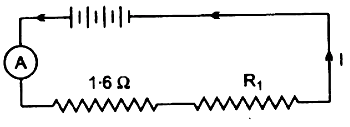
Four cells each of e.m.f.$ 2 V$ and internal resistance $0.1 \Omega$ are connected in series to an ammeter of negligible resistance, a $1.6 \Omega$ resistor and an unknown resistor $R _1$. The current in the circuit is $2 A$ . Draw a labelled diagram and calculate:

(i) Total resistance of the circuit,
(ii) Total e.m.f.
(iii) The value of $R_1$​​​​​​​ and
(iv) The p.d. across $R_1.$
Answer
(i) The resistance in the circuit
$= (1.6 + 4 \times 0.1 + R_1) \Omega$
$= (2 + R_1) \Omega$
(ii) Total e.m.f. = No. of cell × e.m.f. of each cell $= 4 × 2 = 8 V$
(iii) Current in main circuit $i =\frac{\text { Total e.m.f. }}{\text { Total resistance }}$
or $2=\frac{8}{2+ R _1}$
$\therefore R _1=\frac{4}{2}=2 \Omega$
(iv) The p.d. across $R_1= V = i R_1 = 2 \times 2 = 4V$
 
View full question & answer
Question 355 Marks
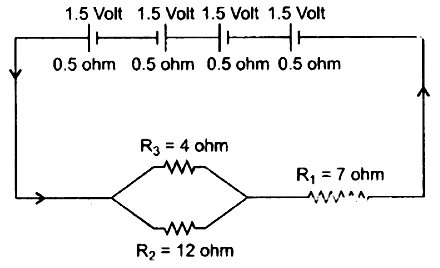
A battery of $4$ cell, each of e.m.f. $1.5$ volt and internal resistance $0.5 Ω$ is connected to three resistances as shown in the figure. Calculate:
(i) The total resistance of the circuit.
(ii) The current through the cell.
(iii) The current through each resistance.
(iv) The p.d. across each resistance.
Answer
Let total e.m.f. of $4$ cells $= nE$ (n = number of cells)

$E = 4 \times 1.5$
$E = 6$ volts    ....(i)
Total internal resistance $= nr (n = 4, r = 0.5 \Omega )$
Total internal resistance $= 4 \times 0.5$ (in series)
$= 2 \Omega      ....(ii)$
Let total external resistance $= X \Omega$
$\frac{1}{R}=\frac{1}{R_1}+\frac{1}{R_2}\left(R_1\right.$ and $R_2$ are in parallel)
$\frac{1}{ R }=\frac{1}{4}+\frac{1}{12}=\frac{3+1}{12}=\frac{4}{12}$
$R =\frac{12}{4}=3 \Omega$
Total external resistance $= X = (R + R_3)\Omega $ (in series)
$X = 3\Omega + 7 \Omega = 10\Omega        .....(iii)$
Total resistance of the circuit $= X + r = 10 + 2 = 12 \Omega$
Total current through the cell = $\frac{E}{X+r}$ ..(as E = I (R + r))
$I =\frac{6}{10+2}=0.5 A \quad$....from (i), (ii) and (iii)
Current through resistor 4 Ω =
$I_1=\frac{I \times R_2}{R_1+R_2}$
$I _1=\frac{0.5 \times 12}{4+12}=\frac{0.5 \times 12}{16}=\frac{0.5 \times 3}{4}$
$l_1=1.5 \times \frac{1}{4}=0.375 A$
Similarly current through resistor $12 \Omega = I_2$
$I _2= I \times \frac{ R _1}{ R _1+ R _2}$
$I _2=0.5 \times \frac{4}{16}=0.5 \times \frac{1}{4}=\frac{1}{8}$
$I_2= 0.125 A.$
$P.D.$ across resistance $7 \Omega = V = I \times R = 0.5 \times 7 = 3.5 V$
$P.D.$ across resistance $4 \Omega = V_1 = V_1 \times R_1 = 0.375 \times 4 = 1.5 V$
$P.D$. across resistance $12 \Omega = V_2 = I_2 \times R_2 = 0.125 \times 12 = 1.5 V.$
View full question & answer
Question 365 Marks
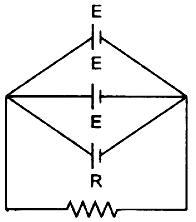
Illustrate-combination of cells e.g., three cells, in parallel, explaining the combination briefly. Obtain an expression for current ‘i’ in the combination.
Answer
Combination of cells in parallel: Let there be n cells, each of e.m.f. E and internal resistance r, be connected in parallel as shown in the diagram.
Total e.m.f. across the point A and B is E

Total internal resistance
$\frac{1}{ r _1}=\frac{1}{ r }+\frac{1}{ r }+\frac{1}{ r } \ldots .=\frac{ n }{ r }$ (if there are $n$ cells)
or $r_1=\frac{r}{n}$
But total resistance of circuit $=R+\frac{r}{n}=\frac{n R+r}{n}$
$\therefore$ Current $i =\frac{\text { Total e.m.f }}{\text { Total resistance }}$
$=\frac{E}{R+\frac{r}{n}}$
$=\frac{ nE }{ nR +r}$
It is advantageous to join cells in parallel when the internal resistance of each cell is quite high as compared to the external resistance R.
Then, Approximately, $i =\frac{ nE }{ r }$ (neglecting $R$ ).
View full question & answer
Question 375 Marks
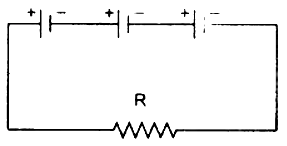
Illustrate-combination of cells e.g., three cells, in series, explaining the combination briefly. Obtain an expression for current ‘i’ in the combination.
Answer
Combination of cells in series:

In this combination, the cells are so connected that the negative terminal of one cell is connected to the positive terminal of the other cell such that in the end one free positive and one free negative terminal are left. These free terminals are connected to the external circuit. If the e.m.f of each cell is E and Y be the internal resistance and I be the current, then e.m.f. of the cell in series = nE (here n = 3)
The total internal resistance = nr
and External resistance = R
∴ Current I in the external circuit
$=\frac{\text { Total e.m.f. }}{\text { Total resistance of the circuit }}$
$I=\frac{n E}{n r+R}$
If $r$ is very small, then neglecting $r$, we get $I=\frac{n E}{R}$
This shows that it is advantageous to connect cells in series to get a large current when their internal resistance is negligible.
View full question & answer
Question 385 Marks
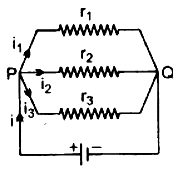
Suppose there are three resistors $A, B$, and $C$ having resistances $r_1, r_2$, and $r_3$ respectively. If $R$ represents their equivalent resistance, establish the following relation $\frac{1}{ R }=\frac{1}{ r _1}+\frac{1}{ r _2}+\frac{1}{ r _3}$,when joined in parallel.
 
Answer
When joined in parallel, let the main current be $i$ which sub-divides at $P$ into $i_1$ in $r_1, i_2$ in $r_2$ and $i_3$ in $r_3$ respectively in given figure.
If potential difference across PQ be V then,
According to Ohm's law:
$i_1 = Vr_1   ...(i)$
$i_2 = Vr_2   ....(ii)$
and $i_3 = Vr_3    ...(iii)$
If R'' be the equivalent resistance of this combination, then
$i =\frac{ V }{ R ^{\prime}}$
From (i), (ii) and (iii) on adding, we get $  ....(B)$
$i = i_1 + i_2 + i_3$​​​​​​​
$=\frac{ V }{ r _1}+\frac{ V }{ r _2}+\frac{ V }{ r _3}$
$= V \left(\frac{1}{ r _1}+\frac{1}{ r _2}+\frac{1}{ r _3}\right)$

Comparing (A) and (B)
$\frac{ V }{ R ^{\prime \prime}}= V \left(\frac{1}{ r _1}+\frac{1}{ r _2}+\frac{1}{ r _3}\right)$
or $\frac{1}{ R ^{\prime \prime}}=\frac{1}{ r _1}+\frac{1}{ r _2}+\frac{1}{ r _3}$
View full question & answer
Question 395 Marks
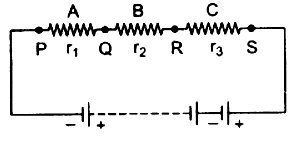
Suppose there are three resistors $A, B,$ and $C$ having resistances $r_1, r_{2,}$ and $r_3$ respectively. If $R$ represents their equivalent resistance, establish the following relation $R = r_1 + r_2+ r_3$ when joined in series.
Answer
Let the three resistors be joined in series in given figure.
Let potential at $P, Q, R$ and $S$ are $V_p, V_Q, V_R$, and $V_S$ respectively and current $i$ flows in the circuit. Applying Ohm's law,
$V_p+ V_Q = ir_1 ...(i)$
$V_Q - V_R = ir_2 ....(ii)$
and $V_R - V_S = ir_3 ....(iii)$
If the total effective resistance between $P$ and $S$ be $R$ ', then the potential difference:
$V_P - V_R = iR' ....(A)$

Adding $(i), (ii)$ and $(iii)$
$V_P - V_Q + V_Q - V_R + V_R - V_S = ir_1 + ir_2 + ir_3$
or $V_P - V_S = i (r_1 + r_2 + r_3) .... (B)$
Comparing (A) and (B), we get
iR' $= i (r_1 + r_2 + r_3)$
or $R' = r_1 + r_2 + r_3$​​​​​​​
View full question & answer
Question 405 Marks
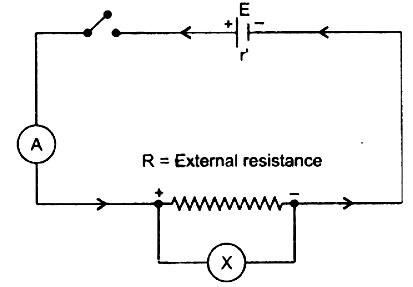
Define the e.m.f. (E) of a cell and the potential difference (V) of a resistor R in terms of the work done in moving a unit charge. State the relation between these two works and the work done in moving a unit charge through a cell connected across the resistor. Take the internal resistance of the cell as ‘r’. Hence obtain an expression for the current i in the circuit.
Answer
E. M. F. of a cell is generally defined as the amount of work done (or the energy spent) in taking a unit positive charge around the complete circuit of the cell (i.e., in the wire outside the cell and the electrolyte within the cell). It is also defined as the potential difference between the terminals of a cell when no current is drawn from it (or when the cell is in open circuit).

Potential difference (p.d.) or the terminal voltage of a cell is generally defined as the amount of work done in carrying a unit positive charge round the circuit connected across the terminals of the cell. If W is the amount of work done (in J) in moving a test charge q between the terminals of a cell through a resistor R, then the p.d. i.e., work done in moving a unit positive charge across the terminals of the cell.
Relation between E, V (p.d.), external resistance R and the internal resistance r’,
Applying Ohm's law to external resistance only
$I=\frac{V}{R}$
Again applying Ohm's law to complete circuit
$I=\frac{E}{R+r}$
Comparing I in (i) and (ii), We have
$\frac{V}{R}=\frac{E}{R+r}$
View full question & answer
[5 Mark Question Answer] - Physics STD 10 Questions - Vidyadip