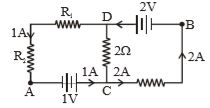
In the circuit shown below, if the potential at point $A$ is taken to be zero, the potential at point $B$ is .............. $V$
Medium
Download our app for free and get started
$\mathrm{V}_{\mathrm{B}}-\mathrm{V}_{\mathrm{A}}=\left(\mathrm{V}_{\mathrm{B}}-\mathrm{V}_{\mathrm{D}}\right)+\left(\mathrm{V}_{\mathrm{D}}-\mathrm{V}_{\mathrm{C}}\right)+\left(\mathrm{V}_{\mathrm{C}}-\mathrm{V}_{\mathrm{A}}\right)$
$=-2+2+1=+1$ $\mathrm{volt}$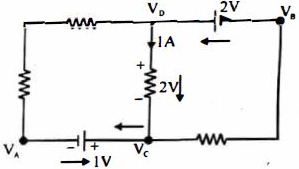

Download our appand get started for free
Experience the future of education. Simply download our apps or reach out to us for more information. Let's shape the future of learning together!No signup needed.*
Similar Questions
- 1The given figure shows $a$ network of resistances and $a$ battery. Identify the correct statement $(s)$View Solution
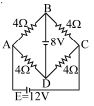
- 2The equivalent resistance between $A$ and $B$ of the network shown in figureView Solution
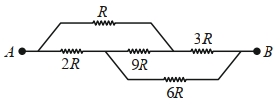
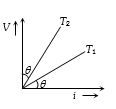
- 3The $V-i$ graph for a conductor at temperature ${T_1}$ and ${T_2}$ are as shown in the figure. $({T_2} - {T_1})$ is proportional toView Solution
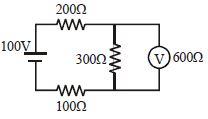
- 4The reading of voltmeter is :- .............. $V$View Solution
- 5On an electric heater $220\, volt$ and $1100\, watt$ are marked. On using it for $4$ hours, the energy consumed in $kWh$ will beView Solution
- 6Two light bulbs in the circuit have rating $A\,[24\ V, 48\,W]$ and $B\,[24\ V, 36\,W]$ as shown.View Solution
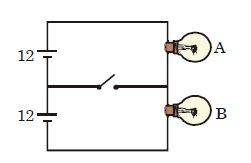
- 7For a cell of $e.m.f.$ $2\,V$, a balance is obtained for $50\, cm$ of the potentiometer wire. If the cell is shunted by a $2\,\Omega $ resistor and the balance is obtained across $40\, cm$ of the wire, then the internal resistance of the cell is ............. $\Omega $View Solution
- 8View SolutionThe reciprocal of resistance is
- 9A copper wire of resistance $R$ is cut into ten parts of equal length. Two pieces each are joined in series and then five such combinations are joined in parallel. The new combination will have a resistanceView Solution
- 10Thomson coefficient of a conductor is $10\,\mu V/K$. The two ends of it are kept at ${50\,^o}C$ and ${60\,^o}C$ respectively. Amount of heat absorbed by the conductor when a charge of $10\,C$ flows through it isView Solution