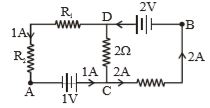
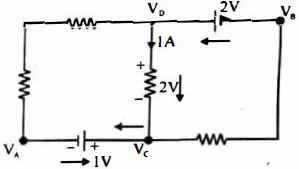
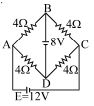
In the circuit shown below, if the potential at point $A$ is taken to be zero, the potential at point $B$ is .............. $V$
Medium


Download our appand get started for free
Experience the future of education. Simply download our apps or reach out to us for more information. Let's shape the future of learning together!No signup needed.*
Similar Questions
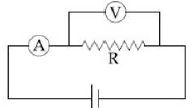
- 1The actual value of resistance $R$, shown in the figure is $30\,\Omega $. This is measured in an experiment as shown using the standard formula $R = \frac{V}{I}$ where $V$ and $I$ are the readings of the voltmeter and ammeter, respectively. If the measured value of $R$ is $5\%$ less, then the internal resistance of the voltmeter is ................. $\Omega$View Solution
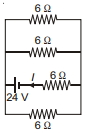
- 2Current $I$ in the network shown in figure is .......... $A$View Solution
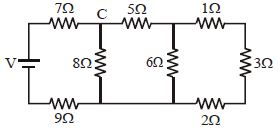
- 3In the ladder network shown, current through the resistor $3\, \Omega$ is $0.25\,A$. The input voltage $'V'$ is equal to:- ........... $V$View Solution
- 4The given figure shows $a$ network of resistances and $a$ battery. Identify the correct statement $(s)$View Solution
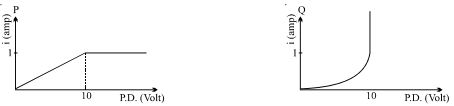
- 5Two current elements $P$ and $Q$ have current voltage characteristics as shown below :View Solution
Which of the graphs given below represents current voltage characteristics when $P$ and $Q$ are in series.
- 6Two wires with resistances $R$ and $2R$ are connected in parallel, the ratio of heat generated in $2R$ and $R$ isView Solution
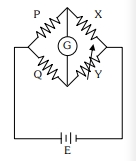
- 7A wheatstone bridge is used to determine the value of unknown resistance $X$ by adjusting the variable resistance $Y$ as shown in the figure. For the most precise measurement of $X$, the resistances $P$ and $Q$:View Solution
- 8The current density in a cylindrical wire of radius $r=4.0 \,mm$ is $1.0 \times 10^{6} \,A / m ^{2}$. The current through the outer portion of the wire between radial distances $r / 2$ and $r$ is $x \pi A$; where $x$ is ..........View Solution
- 9Consider a wire having current $10\,A$ having area of crossection $1\,cm^2$. If number of electrons per unit volume is $9 \times 10^{28}\, m^{-3}$. Find the drift velocity of electronsView Solution
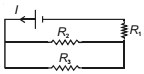
- 10Refer to the circuit shown. What will be the total power dissipation in the circuit if $P$ is the power dissipated in $R_1$ ? It is given that $R_2=4 R_1$ and $R_3=12 R_1$ are .......... $P$View Solution