Two wires with resistances $R$ and $2R$ are connected in parallel, the ratio of heat generated in $2R$ and $R$ is
Easy
Download our app for free and get started
(a) $H = \frac{{{V^2}}}{R}.\,t$ $ \Rightarrow $ $\frac{{{H_1}}}{{{H_2}}} = \frac{{{R_2}}}{{{R_1}}} = \frac{R}{{2R}} = \frac{1}{2}$

Download our appand get started for free
Experience the future of education. Simply download our apps or reach out to us for more information. Let's shape the future of learning together!No signup needed.*
Similar Questions
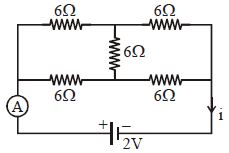
- 1View SolutionReading of ammeter in ampere for the following circuit is
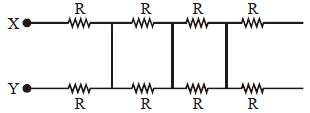
- 2Net resistance between $X$ and $Y$ isView Solution
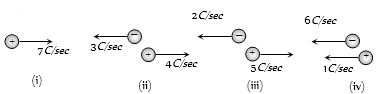
- 3View SolutionFollowing figure shows four situations in which positive and negative charges moves horizontally through a region and gives the rate at which each charge moves. Rank the situations according to the effective current through the region greatest first
- 4A Daniel cell is balanced on $125\,cm$ length of a potentiometer wire. Now the cell is short-circuited by a resistance $2\, ohm$ and the balance is obtained at $100\,cm$. The internal resistance of the Daniel cell is .............. $ohm$View Solution
- 5A student measures the terminal potential difference $(V)$ of a cell $($ of $emf \;\varepsilon $ and internal resistance $r)$ as a function of the current $(I)$ flowing through it. The slope, and intercept, of the graph between $V$ and $I$, then, respectively, equalView Solution
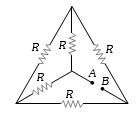
- 6Each of the resistance in the network shown in fig. is equal to $R$. The resistance between the terminals $A$ and $B$ isView Solution
- 7Resistances ${R_1}$ and ${R_2}$ are joined in parallel and a current is passed so that the amount of heat liberated is ${H_1}$ and ${H_2}$ respectively. The ratio $\frac{{{H_1}}}{{{H_2}}}$ has the valueView Solution
- 8An electric kettle has two coils. When one of these is switched on, the water in the kettle boils in $6\,\min$ . When the other coil is switched on, the water boils in $3\,\min$. If the two coils are connected in series, the time taken to boil the water in the kettle is ............. $min$View Solution
- 9A coil develops heat of $800\, cal/sec$. When $20\, volts$ is applied across its ends. The resistance of the coil is .............. $\Omega$ ($1$ $cal$ = $4.2$ $joule$)View Solution
- 10A dry cell has an $e.m.f.$ of $1.5\, V$ and an internal resistance of $0.05\,\Omega $. The maximum current obtainable from this cell for a very short time interval is ................... $A$View Solution