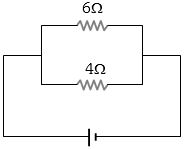
In the circuit shown below, the power developed in the $6$ $\Omega$ resistor is $6\, watt$. The power in watts developed in the $4$ $ \Omega$ resistor is
Medium
Download our app for free and get started
(b) $P = \frac{{{V^2}}}{R}$$ \Rightarrow $ $\frac{{{P_1}}}{{{P_2}}} = \frac{{{R_2}}}{{{R_1}}}$$ \Rightarrow $ $\frac{6}{{{P_2}}} = \frac{4}{6} = \frac{2}{3}$$ \Rightarrow $ ${P_2} = 9\,W$

Download our appand get started for free
Experience the future of education. Simply download our apps or reach out to us for more information. Let's shape the future of learning together!No signup needed.*
Similar Questions
- 1A $3\,^oC$ rise in temperature is observed in a conductor by passing a certain current. When the current is doubled, the rise in temperature will be ............. $^oC$View Solution
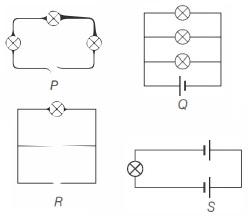
- 2Following figures show different combinations of identical bulb$(s)$ connected to identical battery$(ies)$. Which option is correct regarding the total power dissipated in the circuit?View Solution
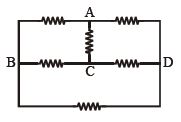
- 3View SolutionIn the following circuit composed of identical resistors, across which terminals would you connect a battery in order to dissipate energy in all resistors
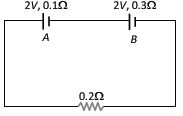
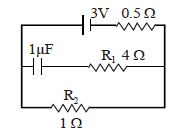
- 4A $1\,\mu F$ capacitor is connected in the circuit shown below. The emf of the cell is $3\ volts$ and internal resistance is $0.5\ ohms$ . The resistors $R_1$ and $R_2$ have values $4\ ohms$ and $1\ ohm$ respectively. The charge on the capacitor in steady state must be.......$\mu C$View Solution
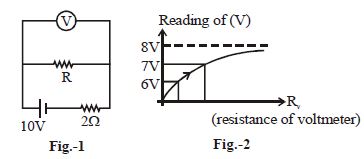
- 5In the given figure $-1$, resistance of shown voltmeter is variable. Variation of whose reading with respect to its resistance is shown in figure $-2$. The value of $R$ is ............... $\Omega$View Solution
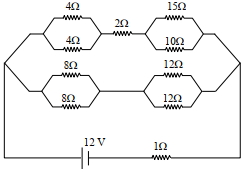
- 6The voltage drop across $15\, \Omega$ resistance in the given figure will be $.....V.$View Solution
- 7Resistance of a wire at $0^{\circ} \mathrm{C}, 100^{\circ} \mathrm{C}$ and $t^{\circ} \mathrm{C}$ is found to be $10 \Omega, 10.2 \Omega$ and $10.95 \Omega$ respectively. The temperature $t$ in Kelvin scale is $\qquad$View Solution
- 8The supply voltage to room is $120\ V$. The resistance of the lead wires is $6\,\Omega$ . A $60\ W$ bulb is already switched on. What is the decrease of voltage across the bulb, when a $240\ W$ heater is switched on in parallel to the bulb? ............. $V$View Solution
- 9A potentiometer wire is $100\,\, cm$ long and a constant potential difference is maintained across it. Two cells are connected in series first to support one another and then in opposite direction. The balance points are obtained at $50\,\, cm$ and $10\,\, cm$ from the positive end of the wire in the two cases. The ratio of emf's isView Solution
- 10The internal resistances of two cells shown are $0.1\,\Omega $ and $0.3\,\Omega $. If $R = 0.2\,\Omega $, the potential difference across the cellView Solution