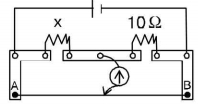
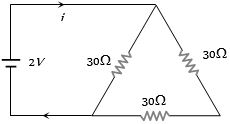
The current in the adjoining circuit will be
IIT 1983, Medium
Download our app for free and get started
(c) ${R_{{\rm{equivalent}}}} = \frac{{(30 + 30)30}}{{(30 + 30) + 30}} = \frac{{60 \times 30}}{{90}} = 20\,\Omega $
$\therefore i = \frac{V}{R} = \frac{2}{{20}} = \frac{1}{{10}}\,ampere$

Download our appand get started for free
Experience the future of education. Simply download our apps or reach out to us for more information. Let's shape the future of learning together!No signup needed.*
Similar Questions
- 1Two wires of the same dimensions but resistivities ${\rho _1}$ and ${\rho _2}$ are connected in series. The equivalent resistivity of the combination isView Solution
- 2The resistance of a wire is $R\; ohm$. If it is melted and stretched to $'n'$ times its original length, its new resistance will beView Solution
- 3A cell of internal resistance $r$ is connected across an external resistance $n r$. Then the ratio of the terminal voltage to the emf of the cell isView Solution
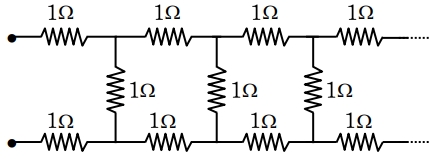
- 4View SolutionThe equivalent resistance of the infinite network given below is :
- 5A heater $A$ gives out $300\, W$ of heat when connected to a $200\, V$ $d.c.$ supply. Asecond heater $B$ gives out $600\, W$ when connected to a $200\,v$ $d.c$. supply. If a series combination of the two heaters is connected to a $200\, V$ $d.c$. supply the heat output will be ................. $W$View Solution
- 6View SolutionAn energy source will supply a constant current into the load if its internal resistance is
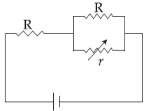
- 7In the circuit shown, the resistance $r$ is a variable resistance. If for $r = fR,$ the heat generation in $r$ is maximum then the value of $f$ isView Solution
- 8What equal length of an iron wire and a copper-nickel alloy wire, each of $2 \; {mm}$ diameter connected parallel to give an equivalent resistance of $3 \Omega ?$View Solution
(Given resistivities of iron and copper-nickel alloy wire are $12 \;\mu \Omega {cm}$ and $51\; \mu \Omega {cm}$ respectively) (in ${m}$)
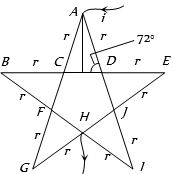
- 9In the following star circuit diagram (figure), the equivalent resistance between the points $A$ and $H$ will be ..............$r$View Solution
- 10A meter bridge is set up as shown, to determine an unknown resistance ' $X$ ' using a standard $10\,ohm$ resistor. The galvanometer shows null point when tapping-key is at $52\,cm$ mark. The endcorrections are $1\,cm$ and $2\,cm$ respectively for the ends $A$ and $B$. The determined value of ' $X$ ' is $..........\Omega$View Solution