MCQ
In the circuit shown here, $E_1=E_2=E_3=2 \mathrm{~V}$ and $R_1=R_2=4 \ \ce{ohms}.$ The current flowing between points $A$ and $B$ through battery $E_2$ is
  • A
    Zero
  • $2 \ \ce{amp}$ from $A$ to $B$
  • C
    $ 2 \ \ce{amp}$ from $B$ to $A$
  • D
    None of the above

Answer

Correct option: B.
$2 \ \ce{amp}$ from $A$ to $B$

Need a full question paper?

Generate a complete, print-ready paper with questions like this in minutes — across 16+ boards, with answer keys.

Start Generating Free

Similar questions

The period of oscillation of a magnet in vibration magnetometer is 2 sec. The period of oscillation of a magnet whose magnetic moment is four times that of the first magnet is(a) 1 sec(b) 4 sec(c) 8 sec  (d) 0.5 sec
       
Current in the circuit is wattless, if.
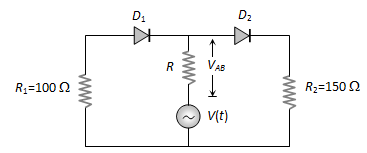
In the circuit given below, $V(t)$ is the sinusoidal voltage source, voltage drop $V_{AB}(t)$ across the  resistance $R$ is
To minimise the power loss in the transmission cables connecting the power stations to homes and factories, the transmission cables carry current:
A 10 μF capacitor is charged to a potential difference of 50 V and is connected to another uncharged capacitor in parallel. Now the common potential difference becomes 20 volt. The capacitance of second capacitor is(a) 10 μF  (b) 20 μF(c) 30 μF(d) 15 μF
       
The narrowest hysterisis loop is for:
A primary cell has an e.m.f. of 1.5 volts, when short-circuited it gives a current of 3 amperes. The internal resistance of the cell is(a) 4.5 ohm (b) 2 ohm(c) 0.5 ohm(d) 1/4.5 ohm
       
If an electron jumps from 1st orbital to 3rd orbital, then it will(a) Absorb energy(b) Release energy(c) No gain of energy(d) None of these
   
   
The angle of dip at the magnetic equator is(a) 0°(b) 45°(c) 30°(d) 90°
       
Assertion  :   The temperature coefficient of resistance is positive for metals and negative for p-type semiconductor.
Reason      : The effective charge carriers in metals are negatively charged whereas in p-type semiconductor they are positively charged.(a) If both assertion and reason are true and the reason is the correct explanation of the assertion.(b) If both assertion and reason are true but reason is not the correct explanation of the assertion.(c) If assertion is true but reason is false.(d) If the assertion and reason both are false.