The resistance of a wire is ${10^{ - 6}}\,\Omega $ per meter. It is bend in the form of a circle of diameter $2\,m$. A wire of the same material is connected across its diameter. The total resistance across its diameter $AB$ will be
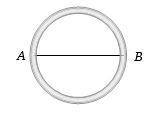
Medium

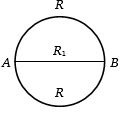

Download our appand get started for free
Experience the future of education. Simply download our apps or reach out to us for more information. Let's shape the future of learning together!No signup needed.*
Similar Questions
- 1The $V-i$ graph for a conductor makes an angle $\theta $ with $V-$ axis. Here $ V$ denotes the voltage and $i$ denotes current. The resistance of conductor is given byView Solution
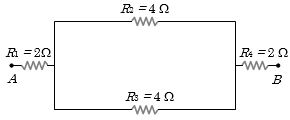
- 2In the given figure, the equivalent resistance between the points $A$ and $B$ is ............ $\Omega$View Solution
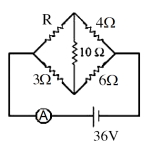
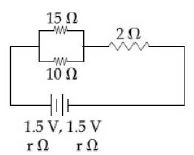
- 3Current measured by the ammeter $(A)$ in the reported circuit when no current flows through $10\,\Omega$ resistance. will be________$A$View Solution
- 4In the given circuit, an ideal voltmeter connected across the $10\,\Omega $ resistance reads $2\, V$. The internal resistance $r$, of each cell is ................... $\Omega$View Solution
- 5Dimensions of a block are $1\,cm \times 1\,cm \times 100\,cm$. If specific resistance of its material is $3 \times {10^{ - 7}}\,ohm - m$, the resistance between the square faces isView Solution
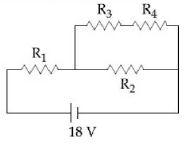
- 6In the given circuit the internal resistance of the $18\,V$ cell is negligible. If $R_1 = 400 \,\Omega ,\,R_3 = 100\,\Omega $ and $R_4 = 500\,\Omega $ and the reading of an ideal voltmeter across $R_4$ is $5\,V,$ then the value of $R_2$ will be ........... $\Omega$View Solution
- 7A beam contains $2 \times 10^8$ doubly charged positive ions per cubic centimeter, all of which are moving with a speed of $10^5 \,m/s$. The current density is ............. $A/m^2$View Solution
- 8The resistivity $(\rho)$ of semiconductor varies with temperature. Which of the following curve represents the correct behaviourView Solution
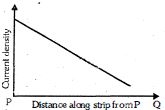
- 9An electric current flows along an insulated strip $PQ$ of a metallic conductor. The current density in the strip varies as shown in graph of figure. Which one of the following statements could explain this variation ?View Solution
- 10Two wires of equal diameters, of resistivities ${\rho _1}$ and ${\rho _2}$ and lengths $l_1$ and $l_2$, respectively, are joined in series. The equivalent resistivity of the combination isView Solution