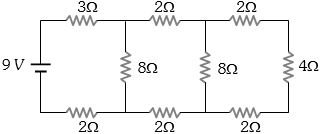
In the circuit shown in the figure, the current through
IIT 1998, Medium
Download our app for free and get started
Equivalent resistance of the circuit $R = 9\,\Omega $
Main current $i = \frac{V}{R} = \frac{9}{9} = 1\,A$
After proper distribution, the current through $4\,\Omega$ resistance is $0.25\, A.$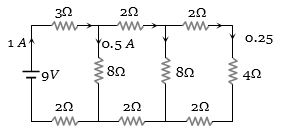

Download our appand get started for free
Experience the future of education. Simply download our apps or reach out to us for more information. Let's shape the future of learning together!No signup needed.*
Similar Questions
- 1If $n,\,e,\,\tau $ and $m$ respectively represent the density, charge relaxation time and mass of the electron, then the resistance of a wire of length $l$ and area of cross-section $A$ will beView Solution
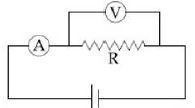
- 2The actual value of resistance $R$, shown in the figure is $30\,\Omega $. This is measured in an experiment as shown using the standard formula $R = \frac{V}{I}$ where $V$ and $I$ are the readings of the voltmeter and ammeter, respectively. If the measured value of $R$ is $5\%$ less, then the internal resistance of the voltmeter is ................. $\Omega$View Solution
- 3Twelve wires of equal length and same cross-section are connected in the form of a cube. If the resistance of each of the wires is $R$, then the effective resistance between the two diagonal ends would beView Solution
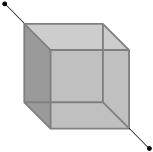
- 4View SolutionThe positive temperature coefficient of resistance is for
- 5Find potential difference across $24\,\Omega $ ............. $\mathrm{volt}$View Solution
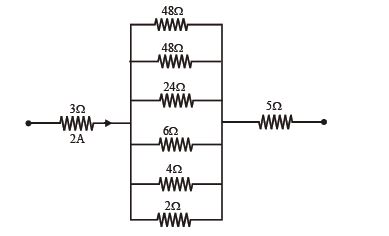
- 6Two resistances ${R_1}$ and ${R_2}$ are made of different materials. The temperature coefficient of the material of ${R_1}$ is $\alpha $ and of the material of ${R_2}$ is $ - \beta $. The resistance of the series combination of ${R_1}$ and ${R_2}$ will not change with temperature, if ${R_1}/{R_2}$ equalsView Solution
- 7In potentiometer experiment when $K_1$ is closed balance length is $100\,cm$. Then what will be balancing length when $K_2$ is closed ................ $\mathrm{cm}$View Solution
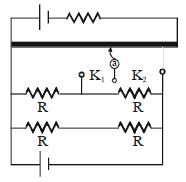
- 8Find the power of the circuit ............ $W$View Solution
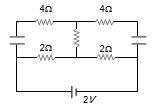
- 9The length of a wire of a potentiometer is $100\, cm$, and the $emf$ of its standard cell is $E\,volt$. It is employed to measure the $e.m.f$ of a battery whose internal resistance is $0.5 \,\Omega$. If the balance point is obtained at $l = 30\, cm$ from the positive end, the $e.m.f.$ of the battery isView Solution
where $i$ is the current in the potentiometer
- 10Figure shows three similar lamp. $L_1,L_2$ and $L_3$ connected across a power supply. If the lamp $L_3$ fuses, how will the light emitted by $L_1$ and $L_2$ change ?View Solution