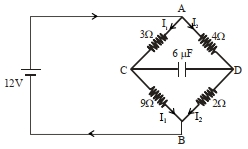
In the circuit shown, the energy stored in the capacitor is $n\,\mu J$. The value of $n$ is ..............
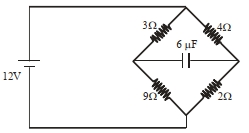
JEE MAIN 2023, Diffcult


Download our appand get started for free
Experience the future of education. Simply download our apps or reach out to us for more information. Let's shape the future of learning together!No signup needed.*
Similar Questions
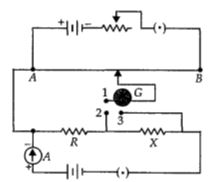
- 1A potentiometer circuit is set up as shown. The potential gradient, across the potentiometer wire, is $k$ $volt/cm$ and the ammeter, present in the circuit, reads $1.0\,\, A$ when two way key is switched off. The balance points, when the key between the terminals $(i)$ $1$ and $2$ $(ii)$ $1$ and $3,$ is plugged in, are found to be at lengths $l_1$ and $l_2$ respectively. The magnitudes, of the resistors $R$ and $X,$ in $ohms$, are then, equal, respectively, toView Solution
- 2The power rating of an electric motor which draws a current of $3.75\, amperes$ when operated at $200\, V$ is aboutView Solution
- 3Two cells of $e.m.f.$ $E_1$ and $E_2$ are joined in series and the balancing length of the potentiometer wire is $625$ $cm$. If the terminals of $E_1$ are reversed, the balancing length obtained is $125 \,cm$. Given $E_2 > E_1$, the ratio $E_1: E_2$ will beView Solution
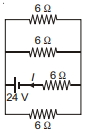
- 4Current $I$ in the network shown in figure is .......... $A$View Solution
- 5In a conductor, if the number of conduction electrons per unit volume is $8.5 \times 10^{28}\, m^{-3}$ and mean free time is $25\,fs$ (femto second), its approximate resistivity is $\left( {{m_e} = 9.1 \times {{10}^{ - 31}}\,kg} \right)$View Solution
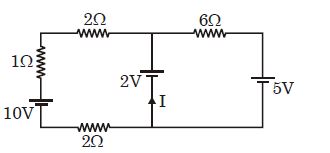
- 6Find the value of $I$ ?................ $\mathrm{A}$View Solution
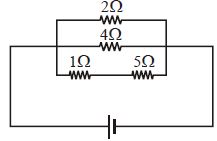
- 7A current of $3\,amp$ flows through the $2\,\Omega $ resistor shown in the circuit. The power dissipated in the $5\,\Omega $ resistor is ................. $watt$View Solution
- 8An electrical power line, having a total resistance of $2 \Omega$, delivers $1 \,kW$ at $220\, V$. The efficiency of the transmission line is approximately $.......\%$View Solution
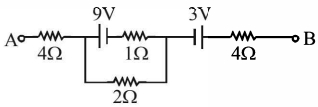
- 9In the circuit shown in figure potential difference between points A and $B$ is $16\,V$. the current passing through $2 \Omega$ resistance will be $...........\,A$View Solution
- 10A rod of length $l$ with thermally insulated lateral surface is made of a material whose thermal conductivity $K$ varies as $K = C/T$ , where $C$ is a constant. The ends are at temperatures $T_1$ and $T_2$ . The heat current density isView Solution