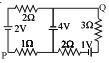
In the circuit shown, what is the potential difference $V_{PQ}$? ................ $V$
Advanced
Download our app for free and get started
In the circuit drawn in currents allotted, apply Kirchoffs Voltage Law in first loop,
$2-2\left(i_{1}\right)+4-1\left(i_{1}\right)=0$
$\Longrightarrow i_{1}=2 A$
since there is no resistance or battery in branch $RQ,$ $V_{R}=V_{Q}$
$\Longrightarrow V_{P Q}=V_{P}-V_{Q}=V_{P}-V_{R}=-2 V+(2 \Omega)(2 A)=+2 V$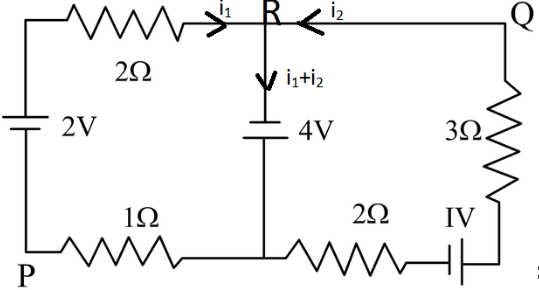

Download our appand get started for free
Experience the future of education. Simply download our apps or reach out to us for more information. Let's shape the future of learning together!No signup needed.*
Similar Questions
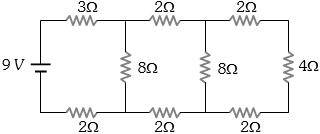
- 1View SolutionIn the circuit shown in the figure, the current through
- 2View SolutionThe electric current passing through a metallic wire produces heat because of
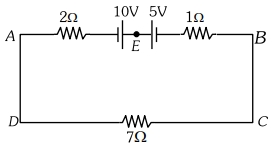
- 3View SolutionThe magnitude and direction of the current in the following circuit is :-
- 4A battery of $6\, volts$ is connected to the terminals of a three meter long wire of uniform thickness and resistance of the order of $100\,\Omega $. The difference of potential between two points separated by $50\,cm$ on the wire will be .......... $V$View Solution
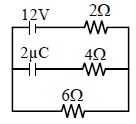
- 5Find the charge on the capacitor $C$ in the given circuit .................. $\mu C$View Solution
- 6The resistance of a wire is $R$. It is bent at the middle by $180^o$ and both the ends are twisted together to make a shorter wire. The resistance of the new wire isView Solution
- 7View SolutionTo draw maximum current from a combination of cells, how should the cells be grouped
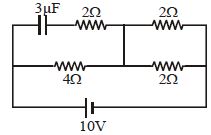
- 8Find charge stored on the capacitor in steady state condition .............. $\mu C$View Solution
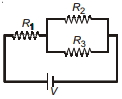
- 9Three identical resistors $R_1=R_2=R_3$ are connected as shown to a battery of constant e.m.f. The power dissipated is ...........View Solution
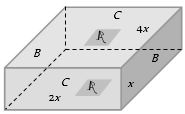
- 10In figure shows a rectangular block with dimensions $x,\, 2x$ and $4x$. Electrical contacts can be made to the block between opposite pairs of faces (for example, between the faces labelled $A-A, B-B$ and $C-C$). Between which two faces would the maximum electrical resistance be obtained ($A-A$ : Top and bottom faces, $B-B$ : Left and right faces, $C-C$ : Front and rear faces)View Solution