MCQ
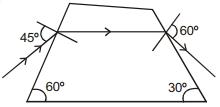
In the diagram, a ray is passing through a broken prism, find angular deviation for the ray
  • A
    $105$
  • B
    $30$
  • C
    $60$
  • $15$

Answer

Correct option: D.
$15$
d
(d)

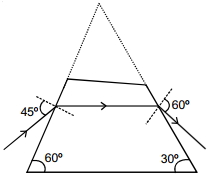
From triangle interior angles

$A=180^{\circ}-60^{\circ}-30^{\circ}$

$=90^{\circ}$

$i+e=A+\delta$

$45^{\circ}+60^{\circ}=90+\delta$

$\therefore \delta=15^{\circ}$
Need a full question paper?

Generate a complete, print-ready paper with questions like this in minutes — across 16+ boards, with answer keys.

Start Generating Free

Similar questions

When objects at different distances are seen by the eye, which of the following remain constant?
A parallel plate air capacitor has capacity $C,$ distance of separation between plates is $d$ and potential difference $V$ is applied between the plates. Force of attraction between the plates of the parallel plate air capacitor is
The rms speed of oxygen molecules in a gas is v. If the temperature is doubled and the oxygen molecules dissociate into oxygen atoms, the rms speed will become:
A pellet carrying charge of $0.5\, coulombs$ is accelerated through a potential of $2,000\, volts$. It attains a kinetic energy equal to
A student studying the similarities and differences between a camera and the human eye makes the following observations:

$I$. Both the eye and the camera have convex lenses.

$II$. In order to focus, the eye lens expands or contracts while the camera lens moves forward or backward.

$III$. The camera lens produces upside down real images while the eye lens produces only upright real images.

$IV$. A screen in camera is equivalent to the retina in the eyes.

$V$. A camera adjusts the amount of light entering in it by adjusting the aperture of the lens. In the eye, the cornea controls the amount of light. Which of the above statements are correct?

When the electron in the hydrogen atom jumps from $2^{nd}$ orbit to $1^{st}$ orbit, the wavelength of radiation emitted is $\lambda$. When the electrons jump from $3^{rd}$ orbit to $1^{st}$ orbit, the wavelength of emitted radiation would be
Relation between principal quantum number ' $n$ ' and radius $r_n$ of Bohr's orbit is:
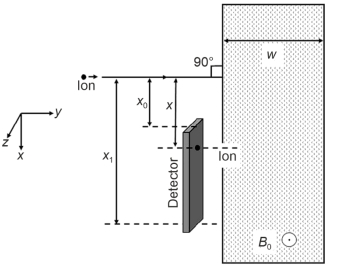
A positive, singly ionized atom of mass number $A_M$ is accelerated from rest by the voltage $192 V$. Thereafter, it enters a rectangular region of width $w$ with magnetic field $B_0=0.1 \hat{k}$ Tesla, as shown in the figure. The ion finally hits a detector at the distance $x$ below its starting trajectory.

[Given: Mass of neutron/proton $=(5 / 3) \times 10^{-27} kg$, charge of the electron $=1.6 \times 10^{-19} C$.]

Which of the following option($s$) is(are) correct?

$(A)$ The value of $x$ for $H^{+}$ion is $4 cm$.

$(B)$ The value of $x$ for an ion with $A_M=144$ is $48 cm$.

$(C)$ For detecting ions with $1 \leq A_M \leq 196$, the minimum height $\left(x_1-x_0\right)$ of the detector is $55 cm$.

$(D)$ The minimum width $w$ of the region of the magnetic field for detecting ions with $A_M=196$ is $56 cm$.
Which one of the following devices makes use of the electrons to strike certain substances to produce fluorescence
Indicate which one of the following system is digital