MCQ
In the electrolytic cell, flow of electrons is from:
- ACathode to anode in solution.
- BCathode to anode through external supply.
- CCathode to anode through internal supply.
- DAnode to cathode through internal supply.
Explanation:
Hint: Electrons flow from the negative to a positive end.
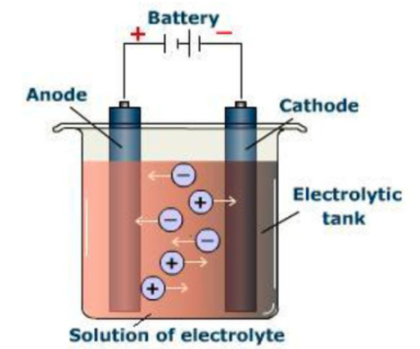
Step 1: A cell in which Electrical energy is used to cause a non-spontaneous oxidation and reduction reaction is called an Electrolytic cell.
The electrolytic cell requires an energy input to proceed.
Step 2: Electrolytic cell contains three parts Cathode, Anode, and electrolyte.
Positive electrode is called anode.
Negative electrode is called Cathode.
An electrolyte is a substance in an aqueous or molten form that dissociates into ions and conducts electricity.
In a electrolytic cell, electrons are transferred from cathode to anode through internal supply.
Generate a complete, print-ready paper with questions like this in minutes — across 16+ boards, with answer keys.
$C{{H}_{3}}-C\equiv CH\xrightarrow[{{H}_{2}}S{{O}_{4}}]{HgS{{O}_{4}}}A\xrightarrow{NaB{{H}_{4}}}B$