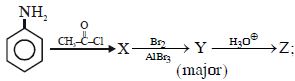
MCQ
In the enolization of the given molecule, the $H$ -atom involved is
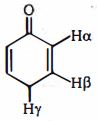
- A$\alpha - H$
- B$\beta - H$
- ✓$\gamma - H$
- Dcannot be enolized
Generate a complete, print-ready paper with questions like this in minutes — across 16+ boards, with answer keys.
$\mathrm{A}+\mathrm{B} \rightarrow \mathrm{C}$
$\text { rate }=\mathrm{k}[\mathrm{A}]^{1 / 2}[\mathrm{~B}]^{1 / 2}$
The reaction is initiated by taking $1 \mathrm{M}$ concentration $A$ and $B$ each. If the rate constant $(k)$ is $4.6 \times 10^{-2} \mathrm{~s}^{-1}$, then the time taken for $\mathrm{A}$ to become $0.1 \mathrm{M}$ is . . . . . . . . . . sec. (nearest integer)
| Mass of dinitrogen | Mass of dioxygen |
| $14\, g$ | $16\, g$ |
| $14\, g$ | $32\, g$ |
| $28\, g$ | $32\, g$ |
| $28\, g$ | $80\, g$ |
Which law of chemical combination is obeyed by the above experimental data ?