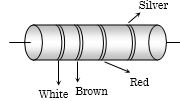
In the figure a carbon resistor has bands of different colours on its body as mentioned in the figure. The value of the resistance is ................. $k \Omega$
Easy
Download our app for free and get started
(d) $R = 91 \times {10^2} \approx 9.1\,k\Omega $.

Download our appand get started for free
Experience the future of education. Simply download our apps or reach out to us for more information. Let's shape the future of learning together!No signup needed.*
Similar Questions
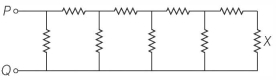
- 1Consider the circuit shown below where all resistors are $1 \,k \Omega$. If a current of magnitude $1 \,mA$ flows through the resistor marked $X$, the potential difference measured between points $P$ and $Q$ are ..............$V$View Solution
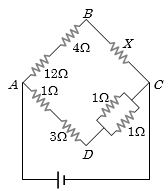
- 2In the circuit shown in the adjoining figure, the current between $B$ and $D$ is zero, the unknown resistance is of ................ $\Omega$View Solution
- 3Voltmeter reads potential difference across the terminals of an old battery as $1.2\,volt$ , while a potentiometer reads $1.4\,volt$ . The internal resistance of battery is $40\,\Omega $ , then voltmeter resistance is .............. $\Omega$View Solution
- 4View SolutionThe conductivity of a superconductor is
- 5This question has Statement $1$ and Statement $2.$ Of the four choices given after the Statements, choose the one that best describes the two Statements.View Solution
Statement $1 :$ The possibility of an electric bulb fusing is higher at the time of switching $ON.$
Statement $2:$ Resistance of an electric bulb when it is not lit up is much smaller than when it is lit up.
- 6A copper wire has a square cross-section, $2.0\, mm$ on a side. It carries a current of $8\, A$ and the density of free electrons is $8 \times {10^{28}}\,{m^{ - 3}}$. The drift speed of electrons is equal toView Solution
- 7View SolutionThe example for non-ohmic resistance is
- 8View SolutionWhich one is not the correct statement
- 9$A$ brass disc and a carbon disc of same radius are assembled alternatively to make a cylindrical conductor. The resistance of the cylinder is independent of the temperature. The ratio of thickness of the brass disc to that of the carbon disc is [$\alpha$ is temperature coefficient of resistance and Neglect linear expansion ]View Solution
- 10View SolutionKirchhoff's second law is based on the law of conservation of