Which one is not the correct statement
Easy
Download our app for free and get started
(c) Because $1\, H.P. = 746\, J/s$ $=$ $746\, watt$

Download our appand get started for free
Experience the future of education. Simply download our apps or reach out to us for more information. Let's shape the future of learning together!No signup needed.*
Similar Questions
- 1A uniform wire of length $l$ and radius $r$ has a resistance of $100\, \Omega $. It is recast into a wire of radius $\frac{r}{2}$. The resistance of new wire will be ............... $\Omega$View Solution
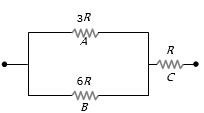
- 2The three resistances $A, B$ and $C$ have values $3R, 6R$ and $R$ respectively. When some potential difference is applied across the network, the thermal powers dissipated by $A, B$ and $C$ are in the ratioView Solution
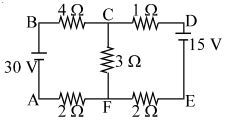
- 3View SolutionThe figure shows a network of five resistances and two batteries Which of the batteries is getting charged.
- 4A copper wire of diameter $1.02\, mm$ carries a current of $1.7\, amp$. Find the drift velocity $(v_d)$ of electrons in the wire. Given $n$, number density of electrons in copper $= 8.5 \times 10^{27} /m^3$....................... $mm/sec$View Solution
- 5A potential $V_0$ is applied across a uniform wire of resistance $R$. The power dissipation is $P_1$. The wire is then cut into two equal halves and a potential of $V _0$ is applied across the length of each half. The total power dissipation across two wires is $P_2$. The ratio $P_2: P_1$ is $\sqrt{x}: 1$. The value of $x$ is $.............$.View Solution
- 6The $H$ amount of thermal energy is developed by a resistor in $10\,s$ when a current of $4\,A$ is passed through it. If the current is increased to $16\,A$, the thermal energy developed by the resistor in $10\,s$ will be $........\,H$View Solution
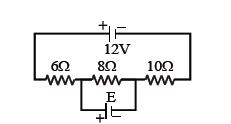
- 7In the circuit shown, the current through $8\,ohm$ issame before and after connecting $E$. The value of $E$ is .................... $\mathrm{V}$View Solution
- 8View SolutionThe resistance of a conductor increases with
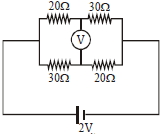
- 9The reading of an ideal voltmer in the circuit shown is.....$V$View Solution
- 10Two resistors of resistance $R_1$ and $R_2$ having $R_1 > R_2$ are connected in parallel. For equivalent resistance $R$, the correct statements isView Solution