Question
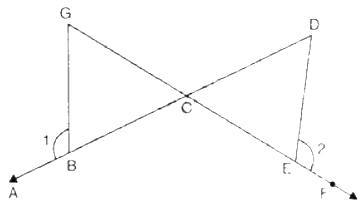
In the figure, $BC = CE$ and $\angle 1 = \angle 2.$ Prove that $\triangle GCB ≅ \triangle DCE.$
​​​​​​​

Answer

In $\triangle GCB$ and $\triangle DCE$ and
$\angle 1 + \angle GBC = \angle 2 + \angle DEC = 180^\circ $
$\angle 1 = \angle 2 =$
$\Rightarrow \angle GBC = \angle DEC$
$BC = CE$
$\angle GCB = \angle DCE = ...($vertically opposite angles$)$
Therefore,
$\triangle GCB ≅ \triangle DCE ....(\text{ASA}$ criteria$)$.

Need a full question paper?

Generate a complete, print-ready paper with questions like this in minutes — across 16+ boards, with answer keys.

Start Generating Free

Similar questions

Draw the graph for the linear equation given below$:x = 0$
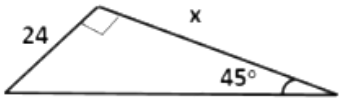
Find the value of $'x\ '$ in each of the following:
Image
Prove that : $\frac{1}{1+x^{b-a}+x^{c-a}}+\frac{1}{1+x^{a-b}+x^{c-b}}+\frac{1}{1+x^{b-c}+x^{a-c}}=1$.
For the equation given below, find the slope and the $y-$intercept:$x= 5y - 4$
Using ruler and compasses only, construct a trapezium $\text{ABCD}$, in which the parallel sides $AB$ and $D$ Care $3.3 \ cm$ apart; $AB = 4.5\ cm, \angle A = 120^o BC = 3.6 \ cm$ and $\angle B$ is obtuse.
If the base of an isosceles triangle is produced on both sides, prove that the exterior angles so formed are equal to each other.
Solve the equations:
$\frac{3}{x+y}+\frac{2}{x-y}=3, \frac{2}{x+y}+\frac{3}{x-y}=\frac{11}{3} \quad\left[\right.$ Hint. Put $\frac{1}{x+y}=u$ and $\left.\frac{1}{x-y}=v\right]$
Image
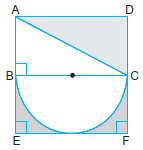
In the given figure, AB = $\frac{1}{2}$ BC, where BC = 14cm $\left(\right.$ Use $\left.\pi=\frac{22}{7}\right)$.
Find:
(i) Area of quad. AEFD
(ii) Area of triangle $\Delta$ABC
(iii) Area of semicircle.
Hence, find the area of shaded region.
Find the number of sides in a regular polygon, when each interior angle is $: 120^\circ$
Image
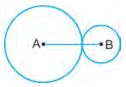
Two circles touch externally. The sum of their areas is 117$\pi$ $cm ^2$ and the distance between their centres is 15 cm. Find the radii of the two circles.
[Hint. $\pi R_1^2+\pi R_2^2=117 \pi \Rightarrow R_1^2+R_2^2=117$. Also, $R_1+R_2=15$.$
\begin{array}{c}
\left(R_1+R_2\right)^2=(15)^2 \Rightarrow\left(R_1^2+R_2^2\right)+2 R_1 R_2=225 \Rightarrow R_1 R_2=\frac{(225-117)}{2}=54 . \\
\therefore\left(R_1-R_2\right)^2=\left(R_1+R_2\right)^2-4 R_1 R_2=(15)^2-4 \times 54=(225-216)=9
\end{array}
$
Now, solve : $R_1+R_2=15$ and $R_1-R_2=3$ ]