Questions

[3 marks sum]

🎯

Test yourself on this topic

18 questions · timed · auto-graded

Question 13 Marks
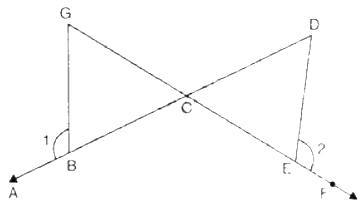
In the figure, $BC = CE$ and $\angle 1 = \angle 2.$ Prove that $\triangle GCB ≅ \triangle DCE.$
​​​​​​​
Answer
In $\triangle GCB$ and $\triangle DCE$ and
$\angle 1 + \angle GBC = \angle 2 + \angle DEC = 180^\circ $
$\angle 1 = \angle 2 =$
$\Rightarrow \angle GBC = \angle DEC$
$BC = CE$
$\angle GCB = \angle DCE = ...($vertically opposite angles$)$
Therefore,
$\triangle GCB ≅ \triangle DCE ....(\text{ASA}$ criteria$)$.
View full question & answer
Question 23 Marks
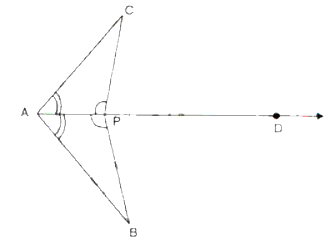
In the figure, $\angle CPD = \angle BPD$ and $AD$ is the bisector of $\angle BAC.$ Prove that $\triangle CAP ≅ \triangle BAP$ and $CP = BP.$
​​​​​​​
Answer
In $\triangle BAP$ and $\triangle CAP$
$\angle BAP = \angle CAP ...(AD$ is the bisector of $\angle BAC)$
$AP = AP$
$\angle BPD + \angle BPA = \angle CPA + \angle CPA = 180^\circ $
$\angle BPD = \angle CPD$
$\Rightarrow \angle BPA - \angle CPA$
Therefore,
$\triangle CAP ≅ \triangle BAP ...(\text{ASA}$ criteria$)$
Hence, $CP = BP.$
View full question & answer
Question 33 Marks
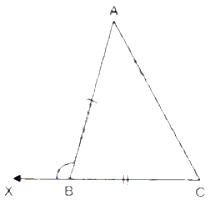
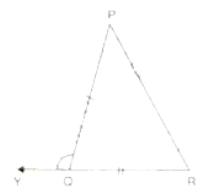
In $\triangle ABC$ and $\triangle PQR$ and, $AB = PQ, BC = QR$ and $CB$ and $RQ$ are extended to $X$ and $Y$ respectively and $\angle ABX = \angle PQY. =$ Prove that $\triangle ABC ≅ \triangle PQR.$
Image
Answer
In $\triangle ABC$ and $\triangle PQR$ and
$AB = PQ$
$BC = QR$
$\angle ABX + \angle ABC$
$= \angle PQY + \angle PQR$
$= 180^\circ $
$\angle ABX = \angle PQY$
$\Rightarrow \angle ABC = \angle PQR$
Therefore,
$\triangle ABC ≅\triangle PQR ....(\text{SAS}$ criteria$).$
View full question & answer
Question 43 Marks
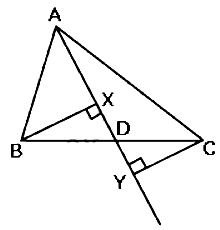
In $\triangle ABC, AD$ is a median. The perpendiculars from $B$ and $C$ meet the line $AD$ produced at $X$ and $Y$. Prove that $BX = CY.$
Answer

In $ \triangle BXD$ and $\triangle CYD$
$\angle BXD = \angle CYD ...(90)$
$\angle XDB = \angle YDC ...($vertically opposite angles$)$
$BD = DC ...(AD$ is median on $BC)$
Therefore$, \triangle BXD ≅ \triangle CYD ...(\text{AAS}$ criteria$)$
Hence, $BX = CY.$
View full question & answer
Question 53 Marks
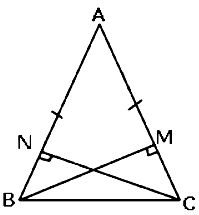
In $\triangle ABC, AB = AC, BM$ and $Cn$ are perpendiculars on $AC$ and $AB$ respectively. Prove that $BM = CN.$
Answer

In $\triangle BNC$ and $\triangle CMB$
$\angle BNC = \angle CMB = 90^\circ $
$\angle NBC = \angle MCB ...(AB = AC)$
$BC = BC$
Therefore, $\triangle BNC ≅ \triangle CMB ...(\text{AAS}$ criteria$)$
Hence, $BM = CN.$
View full question & answer
Question 63 Marks
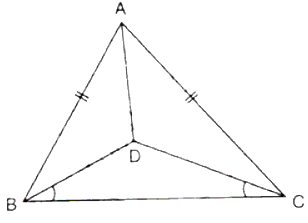
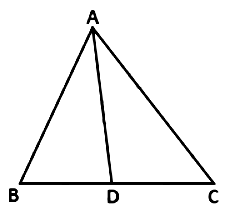
In $\triangle ABC, AB = AC. D$ is a point in the interior of the triangle such that $\angle DBC = \angle DCB.$ Prove that $AD$ bisects $\angle BAC$ of $\triangle ABC.$
​​​​​​​
Answer
Since $AB = AC$
$\angle ABC = \angle ACB$
But $\angle DBC = \angle DBC$
$\Rightarrow \angle ABD = \angle ACD$
Now in $\triangle ABD$ and $\triangle ADC$
$AB = AC$
$AD = AD$
$\angle ABD = \angle ACD$
Therefore, $\triangle ABD ≅ \triangle ADC ...(\text{SSA}$ criteria$)$
Hence, $\angle BAD = \angle CAD$
Thus, $AD$ bisects $\angle BAC.$
View full question & answer
Question 73 Marks
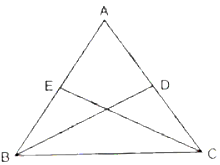
$\triangle ABC$ is isosceles with $AB = AC. BD$ and $CE$ are two medians of the triangle. Prove that $BD = CE.$
Answer
$CE$ is median to $AB$
$\Rightarrow AE = BE ......(i)$
$BD$ is median to $AC$
$\Rightarrow AD = DC ......(i)$
But $AB =AC ......(iii)$
Therefore from $(i), (ii)$ and $(iii)$
$BE = CD$
In $\triangle BEC$ and $\triangle BDC$
$BE = CD$
$\angle EBC = \angle DCB ...($angles opposites to equal sides are equal$)$
$BC = BC ...($common$)$
Therefore, $\triangle BEC \cong \triangle BDC ...(\text{SAS}$ criteria$)$
Hence, $BD = CE.$
View full question & answer
Question 83 Marks
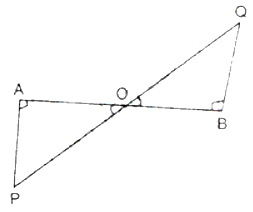
In the figure, $AP$ and $BQ$ are perpendiculars to the line segment $AB$ and $AP = BQ.$ Prove that $O$ is the mid$-$point of the line segments $AB$ and $PQ.$
Answer
Since $AP$ and $BQ$ are perpendiculars to the line segment $AB,$ therefore $Ap$ and $BQ$ are parallel to each other.
In $\triangle AOP$ and $\triangle BOQ$
$\angle PAQ = \angle QBO = 90^\circ $
$\angle APO = \angle BQO ...($alternate angles$)$
$AP = BQ$
Therefore, $\triangle AOP ≅ \triangle BOQ ...(\text{ASA}$ criteria$)$
Hence, $AO = OB$ and $PO = OQ$
Thus, $O$ is the mid$-$point of the line segments $AB$ and $PQ.$
View full question & answer
Question 93 Marks
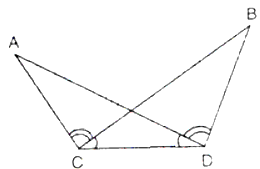
In the figure, $\angle BCD = \angle ADC$ and $\angle ACB =\angle BDA.$ Prove that $AD = BC$ and $\angle A = \angle B.$
Answer
$\angle BCD = \angle ADC$
$\angle ACB = \angle BDA$
$\angle BCD + \angle ACB = \angle ADC + \angle BDA$
$\Rightarrow \angle ACD = \angle BDCACD = BDC$
In $\triangle ACD$ and $\triangle BCD$
$\angle ACD =\angle BDCACD = BDC$
$\angle ADC = \angle BCD$
$ADC = BCD$
$CD = CD$
Therefore, $\triangle ACD ≅ \triangle BCD ...(\text{ASA}$ criteria$)$
Hence, $AD = BC$ and $\angle A = \angle B.$
View full question & answer
Question 103 Marks
In the figure, $AC = AE, AB = AD$ and $\angle BAD = \angle EAC.$ Prove that $BC = DE.$
Image ​​​​​​​
Answer
In $\triangle ADE$ and $\triangle BAC$
$AE = AC$
$AB = AD$
$\angle BAD = \angle EAC$
$\angle DAC = \angle DAC = DAC ...($common$)$
$\Rightarrow \angle BAC = \angle EAD = EAD$
Therefore, $\triangle ADE ≅ \triangle BAC ...(\text{SAS}$ criteria$)$
Hence, $BC = DE.$
View full question & answer
Question 113 Marks
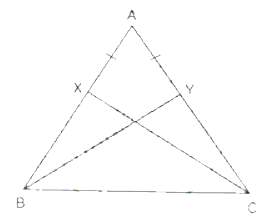
In $\triangle ABC, X$ and $Y$ are two points on $AB$ and $AC$ such that $AX = AY.$ If $AB = AC,$ prove that $CX = BY.$
​​​​​​​
Answer
In $\triangle ABC$
$AB = AC$
$AX = AY$
$\Rightarrow BX = CY$
In $\triangle BXC$ and $\triangle CYB$
$BX = CY$
$BC = BC$
$\angle B = \angle C = C ...(AB = AC$ and angles opposite to equal sides are equal$)$
Therefore, $\triangle BXC ≅ \triangle CYB ...(\text{SAS}$ criteria$)$
Hence, $CX = BY.$
View full question & answer
Question 123 Marks
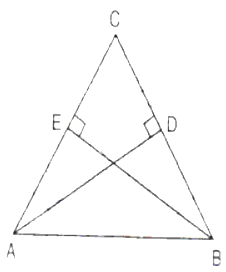
$AD$ and $BE$ are altitudes of an isosceles $\triangle ABC$ with $AC = BC.$ Prove that $AE = BD.$
​​​​​​​
Answer
In $\triangle CAD$ and $\triangle CBE$
$CA = CB ...($Isosceles triangles$)$
$\angle CDA = \angle CEB = 90^\circ $
$\angle ACD = \angle BCE = ...($common$)$
Therefore, $\triangle CAD ≅ \triangle CBE ...(\text{AAS}$ criteria$)$
Hence, $CE = CD$
But,$ CA = CB$
$\Rightarrow AE + CE = BD + CD$
$\Rightarrow AE = BD.$
View full question & answer
Question 133 Marks
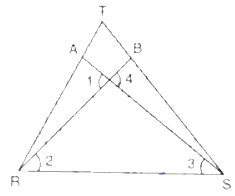
In the figure, $RT = TS, ∠1 = 2∠2$ and $∠4 = 2∠3.$ Prove that $ΔRBT ≅ ΔSAT.$
Answer
$∠1 = 2∠2$ and $∠4 = 2∠3$
$1 = 22$ and $4 = 23∠1 = ∠4 ...($vertically opposite angles$)$
$⇒ 2∠2 = 2∠3$ or $∠2 = ∠3 ........(i)$
$∠R = ∠S = ...($since $RT = TS$ and angle opposite to equal sides are equal$)$
$⇒ ∠TRB = ∠TSA = .........(ii)$
In $ΔRBT$ and $ΔSAT.$
$RT = TS$
$∠TRB = ∠TSA$
$∠RTB = ∠STA = ...($common$)$
Therefore, $ΔRBT ≅ ΔSAT. ...(\text{ASA}$ criteria$)$
View full question & answer
Question 143 Marks
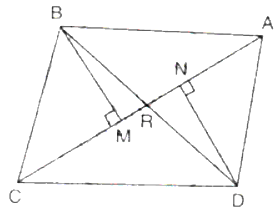
In the figure, $BM$ and $DN$ are both perpendiculars on $AC$ and $BM = DN.$ Prove that $AC$ bisects $BD.$
​​​​​​​
Answer
In $\triangle BMR$ and $DNR$
$BM = DN$
$\angle BMR = \angle DNR = 90^\circ $
$\angle BRM = \angle DRN = ...($vertically opposite angles$)$
Hence, $\angle MBR = \angle NDR ...($sum of angles of a triangle $= 180^\circ )$
$\triangle BMR ≅ \triangle DNR ...(\text{ASR}$ criteria$)$
Therefore, $BR = DR$
So, $AC$ bisects $BD.$
View full question & answer
Question 153 Marks
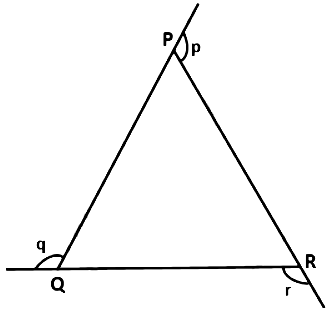
Use the given figure to show that: $\angle p + \angle q + \angle r = 360^\circ .$
​​​​​​​
Answer
By exterior angle property,
$\angle p = \angle PQR + \angle PRQ$
$\angle q = \angle QPR + \angle PRQ$
$\angle r = \angle PQr + \angle QPR$
Now, $\angle p + \angle q + \angle r$
$= \angle PQR + \angle PRQ + \angle QPR + \angle PRQ + \angle PQR + \angle QPR$
$\Rightarrow \angle p + \angle q + \angle r = 2\angle PQR + \angle 2PRQ + 2\angle QPR$
$\Rightarrow \angle p + \angle q + \angle r = 2(\angle PQR + \angle 2PRQ + 2\angle QPR)$
$\Rightarrow \angle p + \angle q + \angle r = 2 \times180^\circ ....[$Angle sum property$: \angle PQR + \angle PRQ + \angle QPR = 180^\circ ]$
$\Rightarrow \angle p + \angle q + \angle r = 360^\circ .$
View full question & answer
Question 163 Marks
If the angles of a triangle are in the ratio $2: 4: 6;$ show that the triangle is a right$-$angled triangle.
Answer
Let the angles of a triangle be $2x, 4x$ and $6x.$
Then, we have
$2x + 4x + 6x = 180^\circ $
$\Rightarrow 12x = 180^\circ $
$\Rightarrow x = 15^\circ $
$\Rightarrow 2x = 2 \times 15^\circ = 30^\circ $
$4x = 4 \times 15^\circ = 60^\circ $
$6x = 6 \times 15^\circ = 90^\circ $
Since one angle is $90^\circ ,$ the triangle is a right$-$angled triangle.
View full question & answer
Question 173 Marks
If each angle of a triangle is less than the sum of the other two angles of it; prove that the triangle is acute$-$angled.
Answer
Consider $\triangle ABC$.
Now, $\angle A<\angle B+\angle C$
$\Rightarrow \angle A+\angle A<\angle A+\angle B+\angle C $
$\Rightarrow 2 \angle A<180^{\circ} $
$\Rightarrow \angle A<\frac{180^{\circ}}{2} $
$\Rightarrow \angle A<90^{\circ}$
Similarly, we have
$\angle B <90^{\circ}$ and  $\angle C <90^{\circ} \text {. }$
Hence, the triangle is acute$-$angled.
View full question & answer
Question 183 Marks
In a triangle $ABC.$ If $D$ is a point on $BC$ such that $\angle CAD = \angle B,$ then prove that$: \angle ADC = \angle BAC.$
Answer

Given,$\angle CAD = \angle B ...(i)$
By exterior angle property,
$\angle ADB = \angle CAD + \angle C$
Also, $\angle ADC = \angle BAD + \angle B$
$\Rightarrow \angle ADC = \angle BAD + \angle CAD ....[$From $(i)]$
$\Rightarrow \angle ADC = \angle BAC.$
View full question & answer
[3 marks sum] - MATHEMATICS STD 9 Questions - Vidyadip