Question
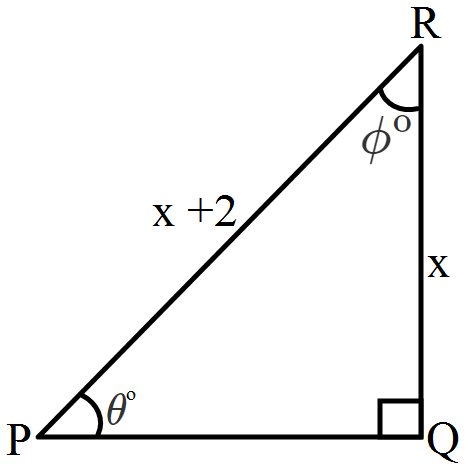
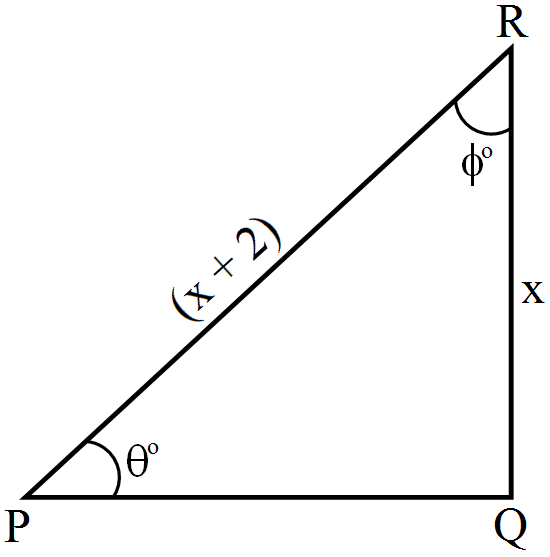
In the figure of $\triangle\text{PQR},\angle\text{P}=\theta^\circ$and $\angle\text{R}=\phi^\circ.$
Find:
  1. $\big(\sqrt{\text{x}+1}\big)\cot\phi$
  2. $\big(\sqrt{\text{x}^3+\text{x}^2}\big)\tan\theta$
  3. $\cos\theta$

Answer


In $\triangle\text{PQR},\angle\text{Q}=90^\circ,\angle\text{P}=\theta^\circ$ and $\angle\text{R}=\phi^\circ$
By Pythagoras theorem, we have
$\text{PQ}^2=\text{PR}^2-\text{QR}^2$
$=\big(\text{x}+2\big)^2-\text{x}^2=\text{x}^2+4\text{x}+4-\text{x}^2=4(\text{x}+1)$
$\Rightarrow\text{PQ}=2\sqrt{\text{x}+1}$
Now, $\cot\phi=\frac{\text{QR}}{\text{PQ}}=\frac{\text{x}}{2\sqrt{\text{x}+1}}$ and $\tan\theta=\frac{\text{QR}}{\text{PQ}}=\frac{\text{x}}{2\sqrt{\text{x}+1}}$
$\big(\sqrt{\text{x}+1}\big)\cot\phi=\big(\sqrt{\text{x}+1}\big)\times\frac{\text{x}}{2\sqrt{\text{x}+1}}=\frac{\text{x}}{2}$
$\big(\sqrt{\text{x}^3+\text{x}^2}\big)\tan\theta=\big(\sqrt{\text{x}^2(\text{x}+1)}\big)\\\tan\theta=\text{x}\big(\sqrt{\text{x}+1}\big)\times\frac{\text{x}}{2\sqrt{\text{x}+1}}=\frac{\text{x}^2}{2}$
$\cos\theta=\frac{\text{PQ}}{\text{PR}}=\frac{2\sqrt{\text{x}+1}}{\text{x}+2}$

Need a full question paper?

Generate a complete, print-ready paper with questions like this in minutes — across 16+ boards, with answer keys.

Start Generating Free

Similar questions

A train travels a distance of $90 \ km$ at a constant speed. Had the speed been $15 \ km/h$ more, it would have taken $30$ minutes less for the journey. Find the original speed of the train.
If $\tan\theta=\frac{4}{3},$ show that $(\sin\theta+\cos\theta)=\frac75.$
Show taht the following points are collinear:A(8, 1), B(3, -4) and C(2, -5)
Find the sum of first 51 terms of an AP whose second and third terms are 14 and 18 respectively.
The following table gives the marks obtained by $50$ students in a class test:
Marks $11-15$ $16-20$ $21-25$ $26-30$ $31-35$ $36-40$ $41-45$ $46-50$
Number of students $2$ $3$ $6$ $7$ $14$ $12$ $4$ $2$

Calculate the mean and median for the above data.

A fraction becomes $\frac { 9 } { 11 }$ if 2 is added to both numerator and denominator. If 3 is added to both numerator and denominator it becomes $ \frac { 5 } { 6 }$. Find the fraction by substitution method.

Solve for x and y:
7(y + 3) - 2(x + 2) = 14,
4(y - 2) + 3(x - 3) = 2
Solve the following quadratic equations by factorization:
$\frac{\text{x}-\text{a}}{\text{x}-\text{b}}+\frac{\text{x}-\text{b}}{\text{x}-\text{a}}=\frac{\text{a}}{\text{b}}+\frac{\text{b}}{\text{a}}$
Solve each of the following given systems of equations graphically and find the vertices and area of the triangle formed by these lines and the y-axis:
5x - y - 7 = 0, x - y + 1 = 0
Find the zeroes of the following polynomials by factorisation method and verify the relations between the zeroes and the coefficients of the polynomials:
$\text{v}^2+4\sqrt{3}\text{v}-15$.