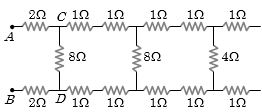
In the figure shown, the total resistance between $A$ and $B$ is ............. $\Omega$
Medium
Download our app for free and get started
The last two resistance are out of circuit.
Now $8\,\Omega $ is in parallel with $(1 + 1 + 4 + 1 + 1)\,\Omega $.
$\therefore R = 8\,\Omega ||8\,\Omega = \frac{8}{2} = 4\,\Omega $ $ \Rightarrow $ ${R_{AB}} = 4 + 2 + 2 = 8\,\Omega $

Download our appand get started for free
Experience the future of education. Simply download our apps or reach out to us for more information. Let's shape the future of learning together!No signup needed.*
Similar Questions
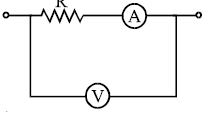
- 1In the circuit shown the resistance of voltmeter is $10,000\, ohm$ and that of ammeter is $20\,ohm$. The ammeter reading is $0.10\,Amp$ and voltmeter reading is $12$ $\mathrm{volt}.$ Then $R$ is equal to .............. $\Omega$View Solution
- 2Space between two concentric conducting spheres of radii $a$ and $b (b > a)$ is filled with $a$ medium of resistivity $\rho $. The resistance between the two spheres will beView Solution
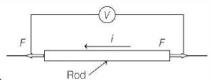
- 3As shown in the schematic below, a rod of uniform cross-sectional area $A$ and length $l$ is carrying a constant current $i$ through it and voltage across the rod is measured using an ideal voltmeter. The rod is stretched by the application of a force $F$. Which of the following graphs would show the variation in the voltage across the rod as function of the strain $\varepsilon$ when the strain is small. Neglect Joule heating.View Solution
- 4In the figure shown, battery $1$ has $\mathrm{emf}$ $= 6\, V$ and internal resistance $= 1 \,\Omega$. Battery $2$ has $\mathrm{emf}$ $= 2\,V$ and internal resistance $= 3\, \Omega$ . The wires have negligible resistance. What is the potential difference across the terminals of battery $2$ ? ................ $V$View Solution
- 5The thermo $e.m.f.$ of a thermo-couple is $25\,\mu V{/^o}C$ at room temperature. A galvanometer of $40\, ohm$ resistance, capable of detecting current as low as ${10^{ - 5}}\,A,$ is connected with the thermocouple. The smallest temperature difference that can be detected by this system is ................ $^oC$View Solution
- 6The drift velocity of electrons in silver wire with cross-sectional area $3.14 \times 10^{-6}\,m ^2$ carrying a current of $20\,A$ is. Given atomic weight of $Ag =108$ , density of silver $=10.5 \times 10^3\,kg / m ^3..........\times 10^{-4} m / sec$.View Solution
- 7By what percentage will the illumination of the lamp decrease if the current drops by $20 \%$ ?View Solution
- 8View SolutionAll of the following statements are true except
- 9View SolutionAssertion : A current continues to flow in superconducting coil even after switch is off.
Reason : Superconducting coils show Meissner effect
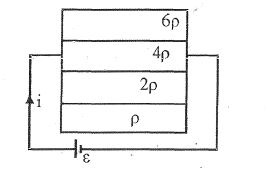
- 10If resistivity of all four wire connected in parallel is different as given in figure and all other dimensions of wire are same then current $i$ is (resistance of wire having resistivity $\rho $ is $R_0$ )View Solution