In the figure, the value of resistors to be connected between $C$ and $D$ so that the resistance of the entire circuit between $A$ and $B$ does not change with the number of elementary sets used is
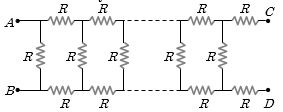
Diffcult
Download our app for free and get started
(b) Cut the series from $XY$ and let the resistance towards right of $XY$ be ${R_0}$ whose value should be such that when connected across $AB$ does not change the entire resistance. The combination is reduced to as shown below.
The resistance across $EF, = {R_{EF}} = ({R_0} + 2R)$
Thus ${R_{AB}} = \frac{{({R_0} + 2R)R}}{{{R_0} + 2R + R}} = \frac{{{R_0}R + 2{R^2}}}{{{R_0} + 3R}} = {R_0}$
$ \Rightarrow R_0^2 + 2R{R_0} - 2{R^2} + 0 \Rightarrow {R_0} = R(\sqrt 3 - 1)$
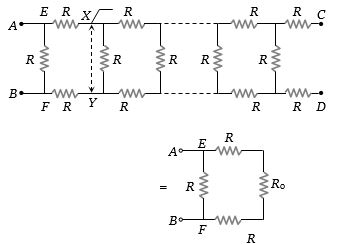
The resistance across $EF, = {R_{EF}} = ({R_0} + 2R)$
Thus ${R_{AB}} = \frac{{({R_0} + 2R)R}}{{{R_0} + 2R + R}} = \frac{{{R_0}R + 2{R^2}}}{{{R_0} + 3R}} = {R_0}$
$ \Rightarrow R_0^2 + 2R{R_0} - 2{R^2} + 0 \Rightarrow {R_0} = R(\sqrt 3 - 1)$

Download our appand get started for free
Experience the future of education. Simply download our apps or reach out to us for more information. Let's shape the future of learning together!No signup needed.*
Similar Questions
- 1Different combination of $3$ resistors of equal resistance $R$ are shown in the figures.View Solution
The increasing order for power dissipation is: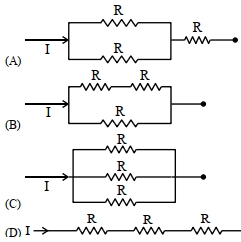
- 2An electric heater of resistance $6 \,ohm$ is run for $10$ minutes on a $120\, volt$ line. The energy liberated in this period of time isView Solution
- 3A wire of resistance $R_{1}$ is drawn out so that its length is increased by twice of its original length.The ratio of new resistance to original resistance is.View Solution
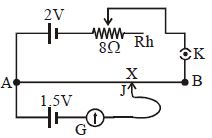
- 4In a potentiometer experiment shown here, for the position $X$ of the jockey $J,$ there occurs a null deflection in the galvanometer. Then the potential difference between points $A$ and $X$ is ................ $V$View Solution
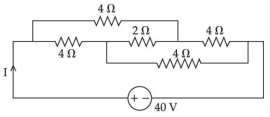
- 5The current $I$ in the given circuit will be $......A$View Solution
- 6Two bulbs of $(40 \;W, 200\; V)$ and $(100\; W, 200 \;V)$. Then correct relation for their resistanceView Solution
- 7The equivalent resistance between $A$ and $B$ is:View Solution
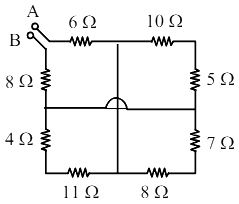
- 8The figure shows three circuits $I, II$ and $III$ which are connected to a $3\,V$ battery. If the powers dissipated by the configurations $I, II$ and $III$ are $P_1 , P_2$ and $P_3$ respectively, thenView Solution
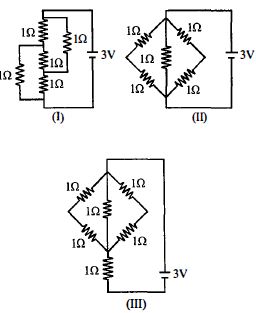
- 9View SolutionAssertion : An electric bulb becomes dim, when the electric heater in parallel circuit is switched on.
Reason : Dimness decreases after sometime.
- 10A wire of resitance $R$ and length $L$ is cut into $5$ equal part. if these parts are joined parts are joined paralley, than result resistance will be:View Solution