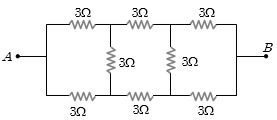
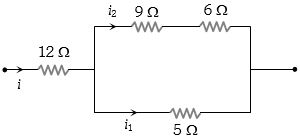
In the following circuit, $5$ $\Omega$ resistor develops $45$ $J/s$ due to current flowing through it. The power developed per second across $12$ $\Omega$ resistor is ............. $W$
Diffcult


Download our appand get started for free
Experience the future of education. Simply download our apps or reach out to us for more information. Let's shape the future of learning together!No signup needed.*
Similar Questions
- 1The current in a simple series circuit is $5.0\, amp$. When an additional resistance of $2.0\, ohms$ is inserted, the current drops to $4.0\, amp$. The original resistance of the circuit in $ohms$ wasView Solution
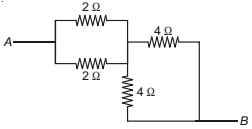
- 2Effective resistance across $A B$ in the network shown in .......... $\Omega$View Solution
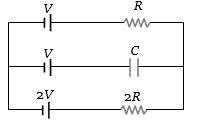
- 3View SolutionIn the given circuit, with steady current, the potential drop across the capacitor must be
- 4A strip of copper and another of germanium are cooled from room temperature to $80\, K$. The resistance ofView Solution
- 5View SolutionElectromotive force is the force, which is able to maintain a constant
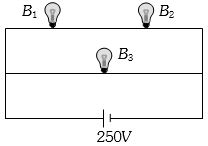
- 6A $100\, W$ bulb $B_1$, and two $60\,W$ bulbs $B_2$ and $B_3$, are connected to a $250\, V$ source, as shown in the figure. Now $ W_1, W_2$ and $W_3$ are the output powers of the bulbs $B_1, B_2$ and $B_3$, respectively. ThenView Solution
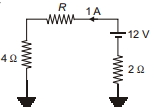
- 7Value of the resistance $R$ in the figure is .......... $\Omega$View Solution
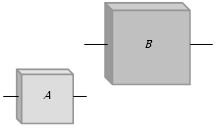
- 8$A$ and $B$ are two square plates of same metal and same thickness but length of $B$ is twice that of $A$. Ratio of resistances of $A$ and $B$ isView Solution
- 9$A$ brass disc and a carbon disc of same radius are assembled alternatively to make a cylindrical conductor. The resistance of the cylinder is independent of the temperature. The ratio of thickness of the brass disc to that of the carbon disc is [$\alpha$ is temperature coefficient of resistance and Neglect linear expansion ]View Solution
- 10Calculate the equivalent resistance between $A$ and $B$View Solution