MCQ
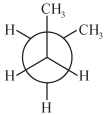
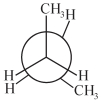
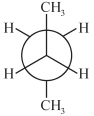
In the following structures, which one is having staggered conformation with maximum dihedral angle?
  • A

  • B


  • D

Answer

Correct option: C.

c
Dihedral angle $:$ It's the angle b/w $2$ specified groups $\left(- CH _{3}\right.$ here $)$

Staggered form is Given in option $( C ) \&$ the angle is $180^{\circ}$

Need a full question paper?

Generate a complete, print-ready paper with questions like this in minutes — across 16+ boards, with answer keys.

Start Generating Free

Similar questions

$Image$

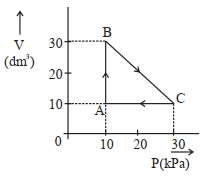
An ideal gas undergoes a cyclic transformation starting from the point $\mathrm{A}$ and coming back to the same point by tracing the path $\mathrm{A} \rightarrow \mathrm{B} \rightarrow \mathrm{C} \rightarrow \mathrm{A}$ as shown in the diagram. The total work done in the process is____ $J$.
Highest $pH =14$  is given by
Incorrect order of ionic radius is
In general, the property (magnitudes only) that shows an opposite trend in comparison to other properties across a period is
The temperature, at which the vapour pressure of a liquid becomes equal to the atmospheric pressure is known as
In the following sequence of reactions $C{H_3}C{H_2}OH\,\xrightarrow{{P + {I_2}}}A\xrightarrow[{Ether}]{{Mg}}B\xrightarrow{{HCHO}}C\xrightarrow{{{H_2}O}}D,$ then compound $'D'$ is
 $\xrightarrow{{conc.\,O\mathop H\limits^ \ominus  }}(A)\xrightarrow{{{H_3}{O^ + }}}(B)$ $\xrightarrow[{2.\,NaOH/CaO/\Delta }]{{1.\,KMn{O_4}}}(C)$

Product $(C)$ is :

For the cell $\mathrm{Cu}(\mathrm{s})\left|\mathrm{Cu}^{2+}(\mathrm{aq})(0.1 \mathrm{M}) \| \mathrm{Ag}^{+}(\mathrm{aq})(0.01 \mathrm{M})\right| \mathrm{Ag}(\mathrm{s})$ the cell potential $\mathrm{E}_{1}=0.3095\, \mathrm{~V}$

For the cell $\mathrm{Cu}(\mathrm{s})\left|\mathrm{Cu}^{2+}(\mathrm{aq})(0.01 \mathrm{M}) \| \mathrm{Ag}^{+}(\mathrm{aq})(0.001 \mathrm{M})\right| \mathrm{Ag}(\mathrm{s})$ the cell potential $=.....\times 10^{-2} \mathrm{~V}$

(Round off to the Nearest Integer).

[Use: $\frac{2.303 \mathrm{RT}}{\mathrm{F}}=0.059$ ]

When anisole is heated with $HI$, the product is
The half-life period of a first order reaction is $100\,\sec$. The rate constant of the reaction is