Question
In the following system of equation determine whether the system has a unique solution, no solution or infinitely many solutions. In case there is a unique solution, find it:
$2x + y = 5$
$4x + 2y = 10$

Answer

The given equations are,
$2x + y = 5 .....(i)$
$4x + 2y = 10 .......(ii)$
The given equations are of the from,
$a_1x + b_1y + c_1 = 0$
$a_2x + b_2y + c_2 = 0$
Where $a_1 = 2, b_1 = 1, c_1= -5$
$a_2 = 4, b_2 = 2$ and $c_2 = -10$
We have,
$\frac{\text{a}_1}{\text{a}_2}=\frac{2}{4}=\frac{1}{2},$
$\frac{\text{b}_1}{\text{b}_2}=\frac{1}{2},$
$\frac{\text{c}_1}{\text{c}_2}=\frac{-5}{-10}=\frac{1}{2}$
$\therefore\frac{\text{a}_1}{\text{a}_2}=\frac{\text{b}_1}{\text{b}_2}=\frac{\text{c}_1}{\text{c}_2}$
Thus, the given system of equations has infinitely many solution.

Need a full question paper?

Generate a complete, print-ready paper with questions like this in minutes — across 16+ boards, with answer keys.

Start Generating Free

Similar questions

Solve the following quadratic equation by factorization:
$a^2b^2x^2 + b^2x - a^2x - 1 = 0$
In a potato race, a bucket is placed at the starting point, which is $5$ m from the first potato, and other potatoes are placed $3$ m apart in a straight line. There are n potatoes in the line (See Fig.).

A competitor starts from the bucket, picks up the nearest potato, runs back with it, drops it in the bucket, runs back to pick up the next potato, runs to the bucket to drop it in, and she continues in the same way until all the potatoes are in the bucket. What is the total distance the competitor has to run?
[Hint: To pick up the first potato and the second potato, the total distance (in metres) run by a competitor is 2 $ \times$ 5 + 2 $ \times$ (5 + 3)]
Two triangles DEF and GHK are such that $\angle\text{D}=48^\circ$ and $\angle\text{H}=57^\circ.$ If $\triangle\text{DEF}\sim\triangle\text{GHK}$ then find the measure of $\angle\text{F}.$
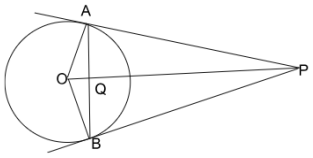
In the given figure, PA and PB are tangents to a circle centred at O. Prove that (i) OP bisects $\angle A P B$ (ii) OP is the right bisector of AB.
Image
ABCD is a quadrilateral in which AD = BC. If P, Q, R, S be the midpoints of AB, AC, CD and BD respectively, show that PQRS is a rhombus.
Prove that the line joining the mid points of any two sides of a triangle is parallel to the third side.
Does there exist a quadratic equation whose coefficients are rational but both of its roots are irrational? Justify your answer.
Prove that $\frac{\sin \theta-2 \sin ^3 \theta}{2 \cos ^3 \theta-\cos \theta}=\tan \theta$.
ABCD is a trapezium in which AB || DC and its diagonals intersect each other at the point O. Show that $\frac{{AO}}{{BO}} = \frac{{CO}}{{DO}}$.
$16$ glass spheres each of radius $2\ cm$ are packed into a cuboidal box of internal dimensions $16\ cm \times 8\ cm \times 8\ cm$ and then the box is filled with water. Find the volume of water fdled in the box.