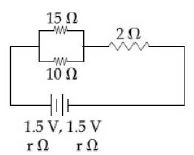
In the given circuit, an ideal voltmeter connected across the $10\,\Omega $ resistance reads $2\, V$. The internal resistance $r$, of each cell is ................... $\Omega$
JEE MAIN 2019, Medium
Download our app for free and get started
$ R_{e q} =\frac{15 \times 10}{25}+2+2 r $
$ =8+2 r $
$i=\frac{3}{8+2 r}$
$2=\mathrm{i} \mathrm{R}_{\mathrm{eq}}=\frac{3}{8+2 \mathrm{r}} \times 6$
$16+4 r=18$
$\Rightarrow r=0.5\, \Omega$

Download our appand get started for free
Experience the future of education. Simply download our apps or reach out to us for more information. Let's shape the future of learning together!No signup needed.*
Similar Questions
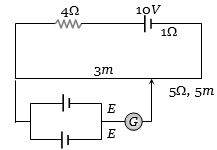
- 1A resistance of $4\,\Omega $ and a wire of length $5\,m$ and resistance $5\,\Omega $ are joined in series and connected to a cell of $e.m.f.$ $10\, V$ and internal resistance $1\,\Omega $. A parallel combination of two identical cells is balanced across $300\, cm$ of the wire. The $e.m.f.$ $E$ of each cell is ........... $V$View Solution
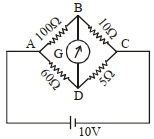
- 2The four arms of a Wheatstone bridge have resistances as shown in the figure. A galvanometer of $15\, \Omega$ resistance is connected across $BD$. Calculate the current through the galvanometer when a potential difference of $10\, V$ is maintained across $AC.$View Solution
- 3In a meter bridge experiment the balance point in obtained if the gaps are closed by $2\,\Omega$ and $3\,\Omega$. A shunt of $x\,\Omega$ is added to $3\,\Omega$ resistor to shift the balancing point by $22.5\,cm$. The value of $X$ is $................$View Solution
- 4Two sources of equal $emf$ are connected to an external resistance $R$. The internal resistances of the two sources are ${R_1}$ and ${R_2}\,({R_2} > {R_1})$. If the potential difference across the source having internal resistance ${R_2}$ is zero, thenView Solution
- 5A potential $V_0$ is applied across a uniform wire of resistance $R$. The power dissipation is $P_1$. The wire is then cut into two equal halves and a potential of $V _0$ is applied across the length of each half. The total power dissipation across two wires is $P_2$. The ratio $P_2: P_1$ is $\sqrt{x}: 1$. The value of $x$ is $.............$.View Solution
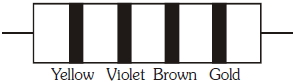
- 6View SolutionThe color code of a resistance is given below
The values of resistance and tolerance, respectively, are :
- 7Potential difference across the $40\,\Omega $ resistance will be ............ $V$View Solution
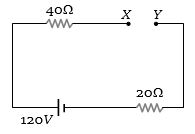
- 8The ammeter reading in the circuit below is .............. $A$View Solution
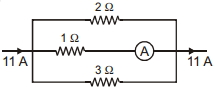
- 9Three voltmeters, all having different internal resistances are joined as shown in figure. When some potential difference is applied across $\mathrm{A}$ and $B$, their readings are $V_1, V_2$ and $V_3$. Choose the correct option.View Solution
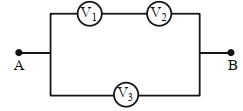
- 10If a $0.1\%$ increase in length due to stretching, the percentage increase in its resistance will be ............ $\%$View Solution