Two sources of equal $emf$ are connected to an external resistance $R$. The internal resistances of the two sources are ${R_1}$ and ${R_2}\,({R_2} > {R_1})$. If the potential difference across the source having internal resistance ${R_2}$ is zero, then
AIEEE 2005,AIIMS 2008, Diffcult
Download our app for free and get started
(d) $i = \frac{{2E}}{{R + {R_1} + {R_2}}}$
From cell $(2)$ $E = V + i{R_2} = 0 + i{R_2}$
$==>$ $E = \frac{{2E}}{{R + {R_1} + {R_2}}} \times {R_2}$
$==>$ $R = {R_2} - {R_1}$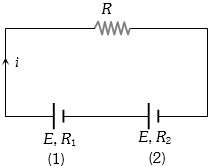

Download our appand get started for free
Experience the future of education. Simply download our apps or reach out to us for more information. Let's shape the future of learning together!No signup needed.*
Similar Questions
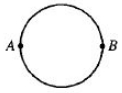
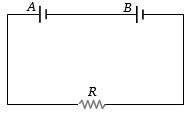
- 1Two batteries $A$ and $B$ each of $e.m.f.$ $2\, V$ are connected in series to an external resistance $R = 1 \,ohm$. If the internal resistance of battery $A$ is $1.9\, ohms$ and that of $B$ is $0.9\, ohm$, what is the potential difference between the terminals of battery $A$ ............. $V$View Solution
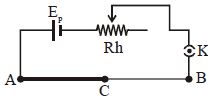
- 2A potentiometer consists of two wires $AC$ and $CB$ of same material and of equal lengths but diameters in the ratio $3 : 1.$ Then the potential gradients on the two wires will be in the ratio :-View Solution
- 3$A$ brass disc and a carbon disc of same radius are assembled alternatively to make a cylindrical conductor. The resistance of the cylinder is independent of the temperature. The ratio of thickness of the brass disc to that of the carbon disc is [$\alpha$ is temperature coefficient of resistance and Neglect linear expansion ]View Solution
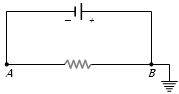
- 4A battery is connected to a uniform resistance wire $AB$ and $B$ is earthed. Which one of the graphs below shows how the current density $J$ varies along $AB$View Solution
- 5A $100\, V$ voltmeter of internal resistance $20\,k\Omega $ in series with a high resistance $R$ is connected to a $110\, V$ line. The voltmeter reads $5\, V$, the value of $R$ is ................ $k \Omega $View Solution
- 6View SolutionTwo bulbs of equal wattage, one having carbon filament and the other having a tungsten filament are connected in series to the mains, then
- 7Water boils in an electric kettle in $20$ minutes after being switched on. Using the same main supply, the length of the heating element should be. . . . . . .to . . . . . .. times of its initial length if the water is to be boiled in $15$ minutes.View Solution
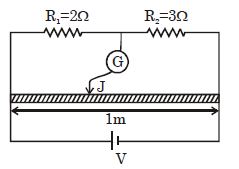
- 8In a meter bridge experiment, initially the jockey is at null point. Now resistance $R_1$ $\&$ $R_2$ is interchanged. Shift in the position of jockey is ................ $cm$View Solution
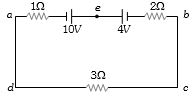
- 9View SolutionThe magnitude and direction of the current in the circuit shown will be
- 10A wire of resistance $12\,ohms$ per meter is bent to form a complete circle of radius $10\, cm.$ The resistance between its two diametrically opposite points, $A$ and $B$ as shown in the figure isView Solution