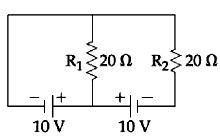
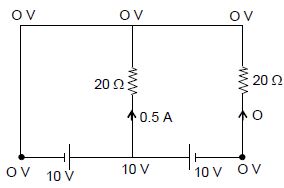
In the given circuit the cells have zero internal resistance. The currents (in Amperes) passing through resistance $R_1$ and $R_2$ respectively, are
JEE MAIN 2019, Medium
Download our app for free and get started

Download our appand get started for free
Experience the future of education. Simply download our apps or reach out to us for more information. Let's shape the future of learning together!No signup needed.*
Similar Questions
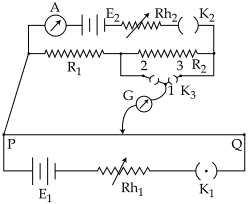
- 1A potentiometer $PQ$ is set up to compare two resistances as shown in the figure. The ameter $A$ in the circuit reads $1.0\, A$ when two way key $K_3$ is open. The balance point is at a length $l_1\, cm$ from $P$ when two way key $K_3$ is plugged in between $2$ and $1$ , while the balance point is at a length $l_2\, cm$ from $P$ when key $K_3$ is plugged in between $3$ and $1$ . The ratio of two resistances $\frac{{{R_1}}}{{{R_2}}}$ is found to beView Solution
- 2View SolutionAssertion : Long distance power transmission is done at high voltage.
Reason : At high voltage supply power losses are less.
- 3The potential difference between points $A$ and $B$ of adjoining figure isView Solution
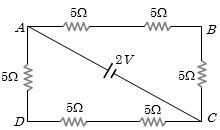
- 4$A$ wire of length $L$ and $3$ identical cells of negligible internal resistances are connected in series. Due to the current, the temperature of the wire is raised by $\Delta T$ in time $t. N$ number of similar cells is now connected in series with a wire of the same material and cross section but of length $2L$. The temperature of the wire is raised by the same amount $\Delta T$ in the same time $t$. The value of $N$ is :View Solution
- 5Two electric bulbs whose resistances are in the ratio of $1 : 2$ are connected in series. The powers dissipated in them have the ratioView Solution
- 6The resistance of all the wires between any two adjacent dots is $R$. Then equivalent resistance between $A$ and $B$ as shown in figure is :View Solution
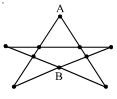
- 7The figure shows a tetrahedron, each side of which has a resistance $r$ If a battery is connected between any two points of the tetrahedron, then identify the correct statement $(s)$.View Solution
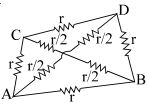
- 8Value of the resistance $R$ in the figure is .......... $\Omega$View Solution
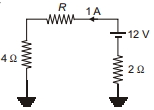
- 9A potential $V_0$ is applied across a uniform wire of resistance $R$. The power dissipation is $P_1$. The wire is then cut into two equal halves and a potential of $V _0$ is applied across the length of each half. The total power dissipation across two wires is $P_2$. The ratio $P_2: P_1$ is $\sqrt{x}: 1$. The value of $x$ is $.............$.View Solution
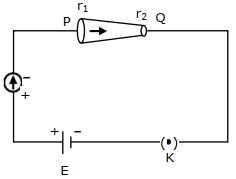
- 10In the given figure, a battery of emf $E$ is connnected across a conductor $P Q$ of length $'Y'$ and different area of cross-sections having radii $r_{1}$ and $r_{2}\left(r_{2}\,<\,r_{1}\right)$.View Solution
Choose the correct option as one moves from $P$ to $Q$ :