MCQ
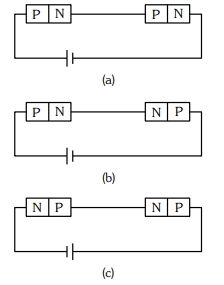
In the given circuits $(a)$,$(b)$ and $(c)$, the potential drop across the two p-n junctions are equal in:
  • A
    Circuit $(b)$ only
  • B
    Circuit $(c)$ only
  • Both circuits $(a)$ and $(c)$
  • D
    Circuit $(a)$ only

Answer

Correct option: C.
Both circuits $(a)$ and $(c)$
c
In $(a)$ $\&$ $(c)$ circuits, both the junctions are in same biasing conditions so offers equal resistances.

Since both are in series, therefore equal potential will drop across the junction.

Need a full question paper?

Generate a complete, print-ready paper with questions like this in minutes — across 16+ boards, with answer keys.

Start Generating Free

Similar questions

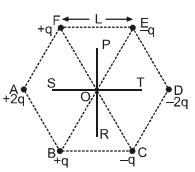
Six point charges are kept at the vertices of a regular hexagon of side $L$ and centre $O$, as shown in the figure. Given that $K=\frac{1}{4 \pi \varepsilon_0} \frac{q}{L^2}$, which of the following statement $(s)$ is (are) correct?

$(A)$ the elecric field at $O$ is $6 K$ along $O D$

$(B)$ The potential at $O$ is zero

$(C)$ The potential at all points on the line $PR$ is same

$(D)$ The potential at all points on the line $ST$ is same.
Boron rods in nuclear reactor are used as a
A metal conductor of length $1\;m$ rotates vertically about one of its ends at angular velocity $5$ radians per second. If the horizontal component of earth's magnetic field is $0.2 \times {10^{ - 4}}\;T$, then the $e.m.f$. developed between the two ends of the conductor is
A capacitor of 10mF charged up to 250 volts is connected in parallel with another capacitor of 5mF charged up to 100 volts. The common potential is
What amount of heat will be generated in a coil of resistance $R$ due to a charge $q$ passing through it if the current in the coil decreases to zero uniformly during a time interval $\Delta t$
Suppose, the electron in a hydrogen atom makes transition from $n = 3$ to $n = 2$ in $10^{-8}s$. The order of the torque acting on the electron in this period, using the relation between torque and angular momentum as discussed in the chapter on rotational mechanics is:
Eddy currents are used in
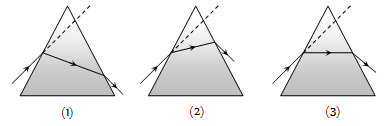
The figures represent three cases of a ray passing through a prism of angle A. The case corresponding to minimum deviation is
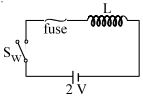
In the circuit shown, the cell is ideal. The coil has an inductance of $4H$ and zero resistance. $F$ is a fuse of zero resistance and will blow when the current through it reaches $5A$. The switch is closed at $t = 0$. The fuse will blow after how much time?
Complete the equation for the following fission process $92^{\mathrm{U}^{235}}+0^{\mathrm{n}^1} \rightarrow 38^{ \mathrm{Sr}^{90}}+\ldots$