Question
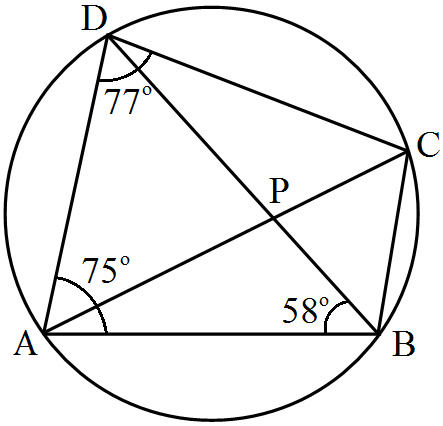
In the given figure, ABCD is a cyclic quadrilateral in which $\angle\text{BAD} = 75^\circ,\ \angle\text{ABD} = 58^\circ$ and $\angle\text{ADC} = 77^\circ, $ AC and BD intersect at P. Then, find $\angle\text{DPC}.$
Answer

In a cyclic quadrilateral it is known that the opposite angles are supplementary, meaning that the opposite angles add up to 180°.
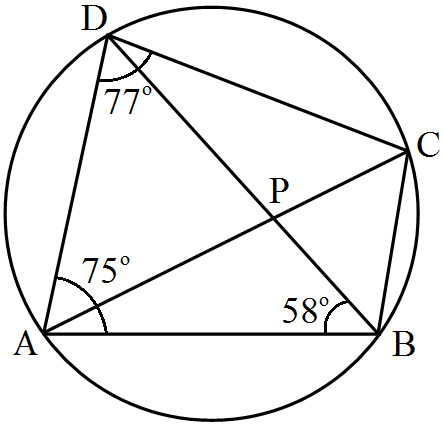
Here we have a cyclic quadrilateral ABCD. The centre of this circle is given as ‘O’.

Since in a cyclic quadrilateral the opposite angles are supplementary, here
$\angle\text{ADC}+\angle\text{ABD}+\angle\text{CBD}=180^\circ$
$\angle\text{CBD}=180^\circ-\angle\text{ADC}-\angle\text{ABD}$
$=180^\circ-77^\circ-58^\circ$
$\angle\text{CBD}=45^\circ$
Whenever a chord is drawn in a circle two segments are formed. One is called the minor segment while the other is called the major segment. The angle that the chord forms with any point on the circumference of a particular segment is always the same.
Here, ‘CD’ is a chord and ‘A’ and ‘B’ are two points along the circumference on the major segment formed by the chord ‘CD’.
So, $\angle\text{CBD}=\angle\text{CAD}=45^\circ$
Now,
$\angle\text{BAD}=\angle\text{BAC}+\angle\text{CAD}$
$\angle\text{BAC}=\angle\text{BAD}-\angle\text{CAD}$
$=75^\circ-75^\circ$
$\angle\text{BAC}=30^\circ$
In any triangle the sum of the interior angles need to be equal to 180°.
Consider the triangle $\triangle\text{ABP},$
$\angle\text{PAB}+\angle\text{ABP}+\angle\text{APB}=180^\circ$
$\Rightarrow\angle\text{APB}=180^\circ-30^\circ-58^\circ$
$\Rightarrow\angle\text{APB}=92^\circ$
From the figure, since ‘AC’ and ‘BD’ intersect at ‘P’ we have,
$\angle\text{APB}=\angle\text{DPC}=92^\circ$
Hence the measure of $\angle\text{DPC}$ is 92°.

Need a full question paper?

Generate a complete, print-ready paper with questions like this in minutes — across 16+ boards, with answer keys.
Start Generating Free

Similar questions

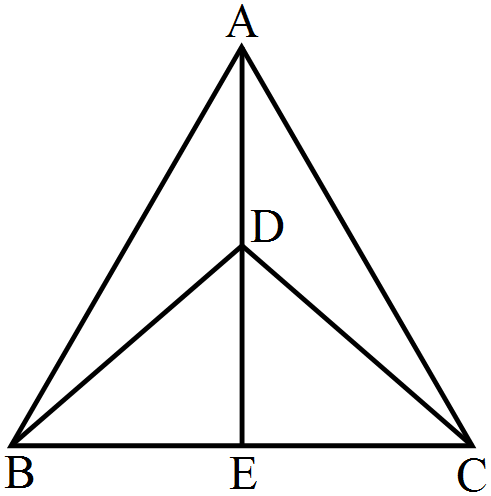
$\triangle\text{ABC}$ and $\triangle\text{DBC}$ are two isosceles triangles on the same base BC and vertices A and D are on the same side of BC. If AD is extended to intersect BC at E, show that:
  1. $\triangle\text{ABD}\cong \triangle\text{ACD}$
  2. $\triangle\text{ABE}\cong\triangle\text{ACE}$
  3. AE bisects $\angle\text{A}$ as well as $\angle\text{D}$
  4. AE is the perpendicular bisector of BC.
In a parallelogram PQRS, PQ = 12cm and PS = 9cm. The bisector of $\angle\text{P}$ meets SR in M. PM and QR both when produced meet at T. Find the length of RT.
The factors of $x^3 - 1 + y^3 + 3xy$ are:
Calculate the area of the triangle whose sides are 18cm, 34cm, 24cm and 30cm in length. Also, find the length of the altitude corresponding to the smallest side. 
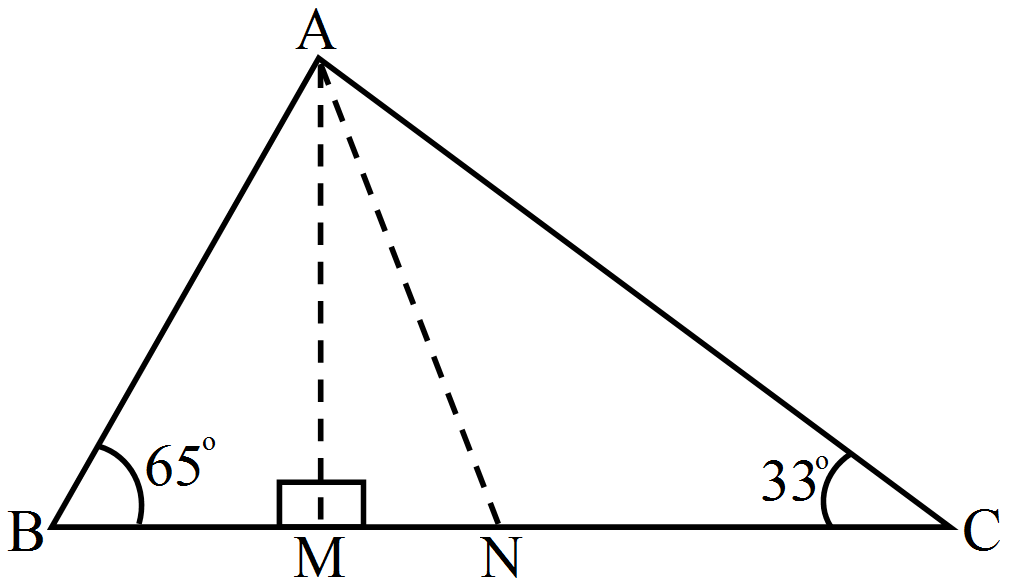
In Fig. $\text{AM}\perp\text{BC}$ and AN is the bisector of $\angle\text{A}.$ If $\angle\text{B}=65^\circ$ and $\angle\text{C}=33^\circ,$ find $\angle\text{MAN}.$
Draw a histogram and the frequency polygon from the following data:
Class interval
20-25
25-30
30-35
35-40
40-45
45-50
Frequency
30
24
52
28
46
10
The total surface area of a solid cylinder is $231\ cm^2$ and its curved surface area is $\frac{2}{3}$ of the total surface area. Find the volume of the cylinder.
Draw the graph of the equation 2x + 3y = 12. From the graph, find the coordinates of the point:
  1. Whose y-coordinates is 3.
  2. whose x-coordinates is -3.
If $(x^3 + ax^2 + bx + 6)$ has $(x - 2)$ as a factor and leaves a remainder $3$ when divided by $(x - 3),$ find the values of $a$ and $b.$
$\text{ABCD}$ is a rectangle and $\text{P, Q, R}$ and $\text{S}$ are mid$-$points of the sides $\text{AB, BC, CD}$ and $\text{DA}$ respectively. Show that quadrilateral $\text{PQRS}$ is a rhombus.