Question
$\triangle\text{ABC}$ and $\triangle\text{DBC}$ are two isosceles triangles on the same base BC and vertices A and D are on the same side of BC. If AD is extended to intersect BC at E, show that:
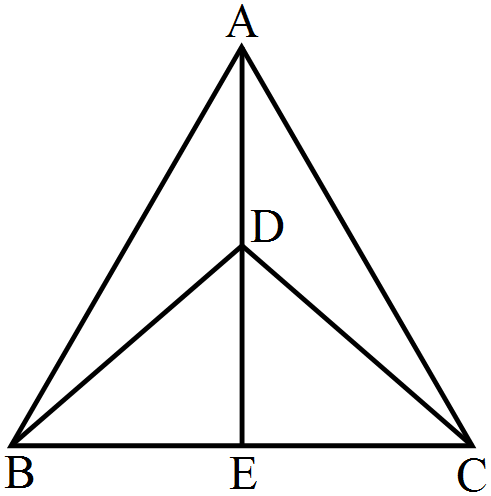
  1. $\triangle\text{ABD}\cong \triangle\text{ACD}$
  2. $\triangle\text{ABE}\cong\triangle\text{ACE}$
  3. AE bisects $\angle\text{A}$ as well as $\angle\text{D}$
  4. AE is the perpendicular bisector of BC.
Answer

  1. In $\triangle\text{ABD}$ and $\triangle\text{ACD},$
$\text{AB = AC}$ $\big($equal sides of isosceles $\triangle\text{ABC}\big)$
$\text{DB = DC}$ $\big($equal sides of isosceles $\triangle\text{DBC}\big)$
$\text{AD = AD}$ (common)
$\therefore\triangle\text{ABD}\cong\triangle\text{ACD}$ (by SSS congruence criterion)
  1. Since $\triangle\text{ABD}\cong\triangle\text{ACD},$
$\angle\text{BAD}=\angle\text{CAD}$ (C.P.C.T.)
$\Rightarrow\angle\text{BAE}=\angle\text{CAE}...(1)$
Now, in $\triangle\text{ABE}$ and $\triangle\text{ACE}$
$\text{AB = AC}$ $\big($equal sides of isosceles $\triangle\text{ABC}\big)$
$\angle\text{BAE}=\angle\text{CAE}$ [From (1)]
$\text{AE = AE}$ (common)
$\therefore\triangle\text{ABE}\cong\triangle\text{ACE}$ (by SAS congruence criterion)
  1. Since $\triangle\text{ABD}\cong\triangle\text{ACD},$
$\angle\text{BAD}=\angle\text{CAD}$ (C.P.C.T.)
$\Rightarrow\angle\text{BAE}=\angle\text{CAE}$
Thus, AE bisects $\angle\text{A}.$
In $\triangle\text{BDE}$ and $\triangle\text{CDE},$
$\text{BD = CD}$ $\big($equal sides of isosceles $\triangle\text{ABC}\big)$
$\text{BE = CE}$ $\big($C.P.C.T. since $\triangle\text{ABE}\cong\triangle\text{ACE}\big)$
$\text{DE = DE}$ (common)
$\therefore\triangle\text{BDE}\cong\triangle\text{CDE}$ (by SSS congruence criterion)
$\Rightarrow\angle\text{BDE}=\angle\text{CDE}$ (C.P.C.T.)
Thus, DE bisects $\angle\text{D},$ i.e., AE bisects $\angle\text{D}.$
Hence, AE bisects $\angle\text{A}$ as well as $\angle\text{D}.$
  1. Since $\triangle\text{BDE}\cong\triangle\text{CDE},$
$\Rightarrow\text{BE = CE}$ and $\angle\text{BED}=\angle\text{CED}=90^{\circ}$ $\big($since $\angle\text{BED}$ and $\angle\text{CED}$ form a linear pair$\big)$
$\Rightarrow\text{DE}$ is the perpendicular bisector of BC.
$\Rightarrow\text{AE}$ is the perpendicular bisector of BC.

Need a full question paper?

Generate a complete, print-ready paper with questions like this in minutes — across 16+ boards, with answer keys.

Start Generating Free

Similar questions

Two circles with centres O and O' intersect at two points A and B. A line PQ is drawn parallel to OO' through A or B, intersecting the circles at P and Q. Prove that PQ = 2OO'.
Find the missing frequencies in the following frequency distribution whose mean is $50.$
$x$ $10$ $30$ $50$ $70$ $90$ Total
$f$ $17$ $f_1$ $32$ $f_2$ $19$ $120$
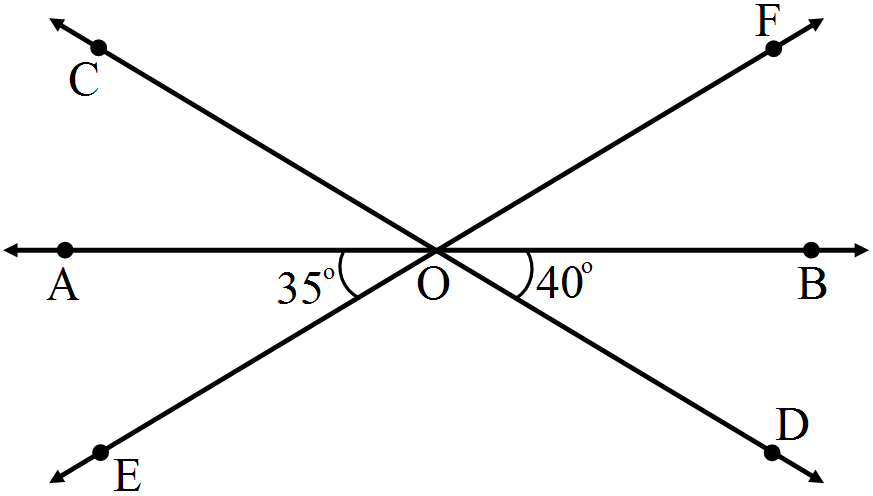
In the given figure, three lines AB, CD and EF intersect at a point O such that $\angle\text{AOE}=35^\circ$ and $\angle\text{BOD}=40^\circ.$ Find the measure of $\angle\text{AOC},\angle\text{BOF},\angle\text{COF}$ and $\angle\text{DOE}.$
Show the diagonals of a square are equal and bisect each other at right angles.
If $p(y) = 4 - 3y -y^2 + 5y^3,$ find:
$i.\ p(0)$
$ii.\ p(2)$
$ii.\ p(-1)$
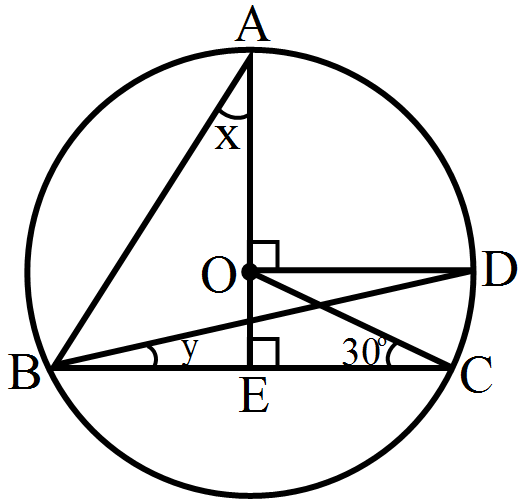
In the given figure, O is the centre of the circle and $\angle\text{BCO}=30^\circ.$ Find x and y.
The table given below shows the ages of 75 teachers in a school.
Age (in years)
18 - 29
30 - 39
40 - 49
50 - 59
Number of teachers
3
27
37
8
A teacher from this school is chosen at random. What is the probability that the selected teacher is:
  1. 40 or more than 40 years old?
  2. Of an age lying between 30 - 39 years (including both)?
  3. 18 years or more and 49 years or less?
  4. 18 years or more old?
  5. Above 60 years of age?
Note: Here 18 - 29 means 18 or more but less than or equal to 29.
ABC is a triangle. The bisector of the exterior angle at B and the bisector of $\angle\text{C}$ intersect each other at D. Prove that $\angle\text{D}=\frac{1}{2}\angle\text{A}.$
Draw the graph for each of the equations x + y = 6 and x - y = 2 on the same graph paper and find the coordinates of the point where the two straight lines intersect.
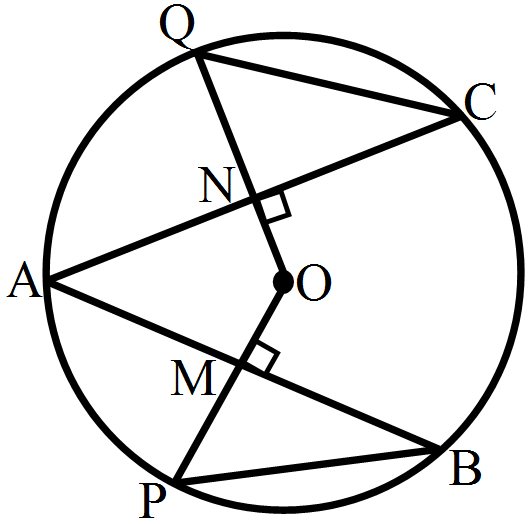
In the adjoining figure, O is the centre of a circle. If AB and AC are chords of the circle such that AB = AC, $\text{OP}\perp\text{AB}$ and $\text{OQ}\perp\text{AC},$
prove that PB = QC.