MCQ
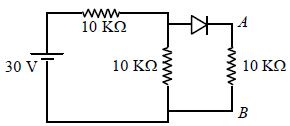
In the given figure potential difference between $A$ and $B$ is :-............. $V$
  • A
    $0$
  • B
    $5$
  • $10$
  • D
    $15$

Answer

Correct option: C.
$10$
c
Since diode in forward bias so it behaves as short circuit.

$\therefore$ equivalent resistance of circuit

$=\left(10+\frac{10 \times 10}{10+10}\right) \mathrm{k} \Omega=15 \mathrm{k} \Omega$

$\therefore$ current through cell $ = \frac{{30}}{{15}}\frac{V}{{{\rm{k}}\Omega }} = 2\,{\rm{mA}}$

$\therefore$ current between $\mathrm{A}$ and $\mathrm{B}=1 \mathrm{\,mA}$

$\therefore V_{A B}=10 \mathrm{\,k} \Omega \times 1 \mathrm{\,mA}=10 \mathrm{\,V}$

$\therefore(3)$

Need a full question paper?

Generate a complete, print-ready paper with questions like this in minutes — across 16+ boards, with answer keys.

Start Generating Free

Similar questions

To increase the resonant frequency in series $LCR$ circuit,
Given below are two statements:

Statement $I$ : Photovoltaic devices can convert optical radiation into electricity.

Statement $II$ : Zener diode is designed to operate under reverse bias in breakdown region.

In the light of the above statements, choose the most appropriate answer from the options given below

Assertion : The clouds in sky generally appear to be whitish.

Reason : Diffraction due to clouds is efficient in equal measure at all wavelengths.
The angular momentum of an electron in the hydrogen atom is $\frac{{3h}}{{2\pi }}$ . Here $h$ is Planck’s constant. The kinetic energy of this electron is.....$eV$
A flat circular disc has a charge +Q uniformly distributed on the disc. A charge +q is thrown with kinetic energy E towards the disc along its normal axis. The charge q will
Light wave enters from medium $1$ to medium $2.$ Its velocity in $2^{\text {nd }}$ medium is double from $1^{\text {st }}$. For total internal reflection the angle of incidence must be greater than
Give the SI unit of magnetic dipole moment.
Two points $P$ and $Q$ are maintained at the potentials of $10\, V$ and $-4\,V$, respectively. The work done in moving $100$ electrons from $P$ and $Q$ is
The work done by the external forces on a system equals the change in:
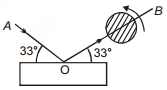
A beam of light $A O$ is incident on a glass slab $(m=1.54)$ in a direction as shown in the diagram. The reflected ray $O B$ is passed through a polariod. On viewing through the polariod, we find that on rotating the polariod $\left(\right.$ Given $\left.\tan 57^{\circ}=1.54\right)$