MCQ
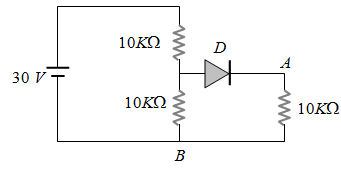
In the given figure, potential difference between $A$ and $B$ is
  • A
    $0$
  • B
    $5$ volt
  • $10$ volt
  • D
    $15$ volt

Answer

Correct option: C.
$10$ volt
$10$ volt

Need a full question paper?

Generate a complete, print-ready paper with questions like this in minutes — across 16+ boards, with answer keys.

Start Generating Free

Similar questions

A polaroid is placed at $45^{\circ}$ to an incoming light of intensity $\mathrm{I}_0.$ Now the intensity of light passing through polaroid after polarisation would be
Which of the following statement is correct in accordance with Kirchhoff's second law?
A normally incident ray reflected at an angle of 90°. The value of critical angle is(a) 45°(b) 90°(c) 65°(d) 43.2°
       
X-rays were discovered by(a) Becquerel(b) Roentgen(c) Marie Curie(d) Von Laue
       
For a colour of light the wavelength for air is $6000 \mathring A$ and in water the wavelength is $4500 \mathring A .$ Then the speed of light in water will be
A current $i$ passes through a wire of length $l$, radius of cross$-$section $r$ and resistivity $\rho$. The rate of heat generation is
Assertion  :   The earth’s magnetic field is due to iron present in its core.
Reason      : At a high temperature magnet losses its magnetic property or magnetism.(a) If both assertion and reason are true and the reason is the correct explanation of the assertion.(b) If both assertion and reason are true but reason is not the correct explanation of the assertion.(c) If assertion is true but reason is false.(d) If assertion is false but reason is true.


Which of the following is a fusion reaction?
Cutoff wavelength of $X-$rays coming from a Coolidge tube depends on the:
Consider a ray of light incident from air onto a slab of glass (refractive index n) of width d, at an angle θ. The phase difference between the ray reflected by the top surface of the glass and the bottom surface is: